
No Sex Please, We’re the British Psychological Society
After the BPS bans sex and pronouns at annual conference, TERF Times takes a gander at the organisation’s history of surrender to trans activists
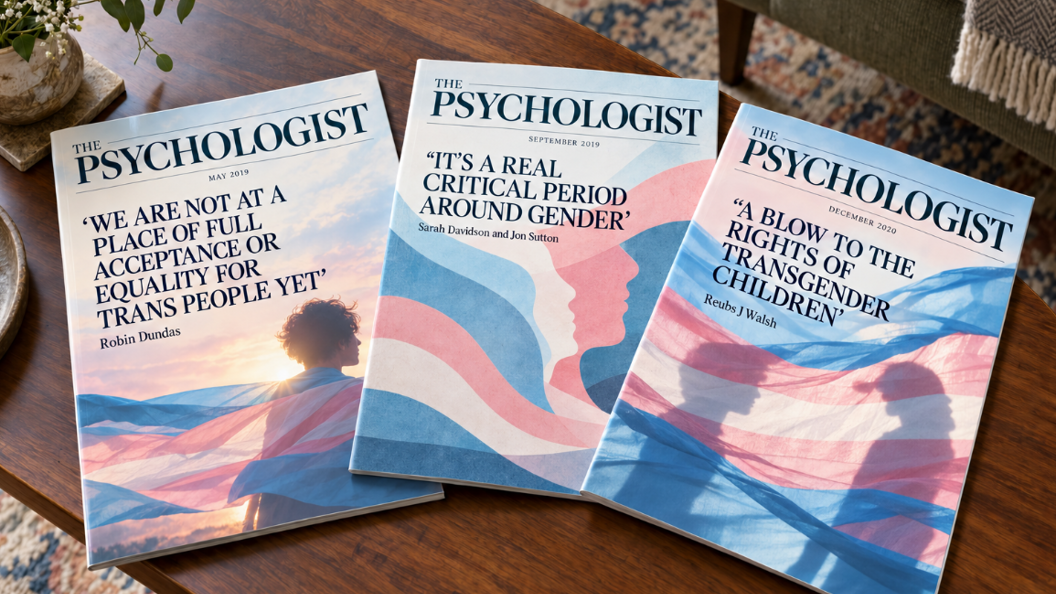
The British Psychological Society (BPS) is discouraging members from acknowledging the concept of biological sex, in the organisation’s latest assault on science and reality.
The agenda for the Society’s 2026 Division of Educational and Child Psychology (DECP) annual conference urges delegates to avoid using sex-specific forms of address, urges them to refer to individuals with the plural they/their rather than he/she, avoid specifying someone’s sex “unless it is relevant” – and even to shun pronouns entirely.
The BPS, which represents psychology and psychologists in the UK, has a troubled and at times schizophrenic approach to gender identity ideology. The organisation was quick to welcome the Cass Review and has stated its commitment to multi-disciplinary approaches to treating gender-distressed people. In the same breath, however, it legitimises neo-sexualities and identities, including asexual, agender, non-binary, and pansexual.
Two months after its embrace of Cass, the BPS published its Guidelines for Psychologists Working with Gender, Sexuality and Relationship Diversity, a document deeply influenced by gender ideologues. Its ‘Further reading’ section includes links to publications by trans activist organisations including Stonewall, LGBT Foundation, and the reputationally-bankrupt WPATH, whose Standards of Care advocates for the existence of a “eunuch” gender identity.
The lead author of the BPS Gender Guidelines for adults, Christina Richards, is a trans-identified man; he also led the 2024 review of the guidelines. Richards also served on the Executive Board of WPATH, and was selected to be lead chapter author for Adult Assessment in the Standards of Care Version 8.
This is far from the first time the BPS has tried to erase sex. In its own Code of Conduct, the Ethical [sic] Principles state: “Respect for dignity recognises the inherent worth of all human beings, regardless of perceived or real differences in social status, ethnic origin, gender, capacities, or any other such group-based characteristics.” Tellingly, it does not specify biological sex.
Any claim the BPS might have to impartiality was obliterated this summer after the editor of its in-house magazine The Psychologist declined to publish an advertisement for the ‘Rethinking Youth Gender Medicine’ conference at UCL.
In an email seen by TERF Times, the Society’s CEO Sarb Bajwa defended the decision, which was “taken in consultation with colleagues and the Board of Trustees”. Bajwa claims that “consideration was given to the highly contested nature of the subject matter, the society’s ongoing policy work in this area, and the potential…to be perceived as endorsement of a particular position.”
Significantly, one of the speakers at the conference, Professor Sallie Baxendale, was hounded by transactivists for refusing to accept NHS-endorsed claims that puberty blockers (PBs) are safe and reversible. Baxendale’s research into PBs’ impact on cognitive function was rejected by multiple journals following a sustained campaign of bullying and harassment, including from colleagues – an experience she recounted on the latest edition of BBC Radio 4’s Inside Science.
As with the British Medical Association (see TERF Times passim), the BPS has attracted flak from its own members. Among the organisation’s biggest ulcers are clinical psychologists
Pat Harvey, David Pilgrim, and Peter Harvey of BPSWatch.com. In 2024, they wrote an excoriating open letter to the Chair of its Practice Board, Professor Tony Lavender, drawing his attention to multiple failings in its gender Guidelines (see above).
The authors deplored the Guidelines’ downplaying of serious mental health problems in gender-confused adults and children, and its encouragement of an essentialist view of gender identity as a coherent psychological phenomenon. “This ‘stick of rock’ approach to personal identity reifies transgender-identifying patients as if they are all psychologically identical, which is crass and implausible,” the letter continued.
Harvey is in no doubt that BPS is fully captured by the trans activist lobby. Speaking to TERF Times, she noted how large professional organisations like the BPS are particularly vulnerable to entryism and the infamous Denton’s strategy. “When most members are focusing on their career, ambitious ideological activists can attain senior positions if they are willing to put in the effort, and over time can cause a huge amount of damage,” she said.
For example, Harvey points to Jon Sutton, editor of The Psychologist for almost three decades. Sutton has written that, on the contentious issue of gender, he will prioritise contributions “from trans people and those who work with them”. Harvey claims that colleagues who dissent from gender identity ideology “have had to fight often unsuccessfully to get critical and reflective pieces or responses into print” and these are almost always printed with a caveat.
Other examples of bias abound in the pages of The Psychologist, including its tendentious treatment of bitterly-contested gender issues. These include uncritical inclusion of articles by trans and non-binary activists and – shockingly – publishing a link to the GenderGP website as late as 2025, after even the NHS had cut ties with the disgraced Helen Webberley’s outfit. Harvey says she wrote a formal letter of complaint that was “batted away” by the editorial board; the link remained until a judge publicly condemned GenderGP in family court.
Captured the BPS may very well be, but it is clearly capable of shifting in the wind of public opinion. One of the starkest examples is its former support for a “trans-inclusive” ban on conversion therapy in 2022, a position from which it resiled this June when the BPS published its response to the draft Conversion Practices Bill. This statement urged legislators to “be very clear that [the bill] would not prevent ethical and evidence based forms of therapy.”
The BPS may hope that the gender war will be resolved before it does further damage to its reputation. TERF Times’ advice? The Society should have a good, long think about whether it wants to be a signpost for an evidence-based profession or just another weathercock swinging in the breeze.