Why say trans?
From cross-dressing men to children prescribed puberty blockers, 'trans' lumps together radically different people and problems; Louise Guinness asks is the term still useful?
We’re losing ground. It’s depressing and I think we need to get radical. In her updated statement on X a few days ago JK Rowling said ‘I have never denied that people who call themselves trans exist and in the UK, they rightly have exactly the same rights as every other citizen.’ Of course they do. People who call themselves two-spirit and those who adopt the Jedi philosophy have the same rights as every other citizen, they can call themselves whatever they like. The problem is by talking about trans people as an accepted and homogeneous group we’re sailing right over the top of some major issues, the worst of which is that a trans person develops from a trans child. Unbelievably we’re back to that.
Yesterday Jayne Ozanne, founder of the Ban Conversion Practices Coalition and the Ozanne Foundation gave evidence to the Joint Committee on the Draft Conversion Practices Bill and she said: “most trans children I’m aware of know from the very get-go…it’s not just a fad…they are trapped in the wrong body”. This is surely criminal stupidity?
The pathologisation of gender non-conformity is very recent. In The Diagnostic and Statistical Manual of Mental Disorders (DSM) Transvestism is listed as a sexual deviation from 1968. In 1980 Transsexualism was added, along with Gender Identity Disorder of Childhood (GIDC) and in 2022 Gender Incongruence made its first appearance in the manual.
Once Gender Dysphoria became a diagnosis, pharmaceutical companies rummaged around in their lockers to re-purpose drugs to ‘cure’ the distressed youngsters. Puberty-blockers used in the 1980s for precocious puberty or to treat prostate cancer began to be prescribed in youth gender clinics which proliferated all over the United States and here in the UK. The Gender Identity Development Service (GIDS) at the Tavistock and Portman NHS Foundation Trust was officially closed on 31 March 2024.
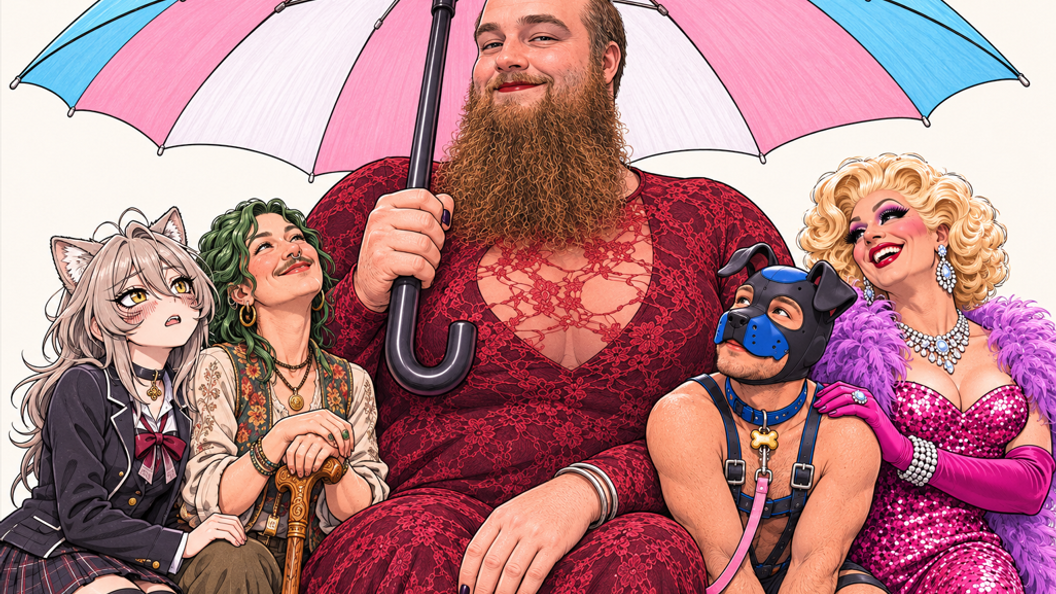
People who call themselves trans include heterosexual males who are turned on by dressing up as women. This cohort, formerly known as cross-dressers, transvestites or trannies has got larger and younger. Emboldened by online sissy porn and sheltered by the trans umbrella they scream about vulnerability while intimidating women.
Teenage girls who are unhappy with their developing bodies are also calling themselves trans and in the year 2024-2025 there was a 52% increase in elective mastectomies. The trans label is being used by Munchausen by proxy parents – little boyish girls or their little girlish boys are called trans.
A medical scandal is unfolding with the current puberty-blocker trial, waved through by government and cheered on by those who’ve failed to understand that gender non-conformity does not need a chemical approach. The drugs have lifelong consequences.
And yet our arguments are not penetrating. Many young people suffer from groupthink on the issue. My 30-year-old son says there’s no way he can discuss the subject with his friends (proud to say he’s a TERF, though by necessity he’s in the closet). He says it’s a given that JK Rowling is a villain – they refer to her as if she’s gone mad, without ever actually reading what she’s said on the subject. Stonewall’s policy of No Debate has had a lasting silencing effect, and many people think that the moment you start talking about trans you’re guilty of transphobia which they conflate with homophobia and that just proves you’re a bad person and should be burning in hell. Sigh.
So we need to try something new – let’s stop using the T word. We need to always ask for someone to say who they’re thinking about when they say trans person. Is it their sweet friend who ‘passes’ and just wants to pee, is it their friend’s teenage daughter who might be on the spectrum and is seeking answers to a diagnosis of gender dysphoria imposed on her by doctors and her peers? Is it a feminised male or a young lesbian either of whom may have internalised homophobia? And when they answer we can say it’s all fine – just don’t do the drugs, don’t do the surgeries, respect single-sex spaces. Maybe these people are bisexual, maybe they’d like to call themselves non-binary? The word trans is no longer fit for purpose.
If you enjoyed this piece the author has asked that you please show your support by donating to registered charity, Sex Matters.