
The Lady in Blue is not for stopping
This article was first published online in The Critic. Tschabalala Self’s Fourth Plinth sculpture is neither a woke monstrosity nor a masterpiece: it’s just fun
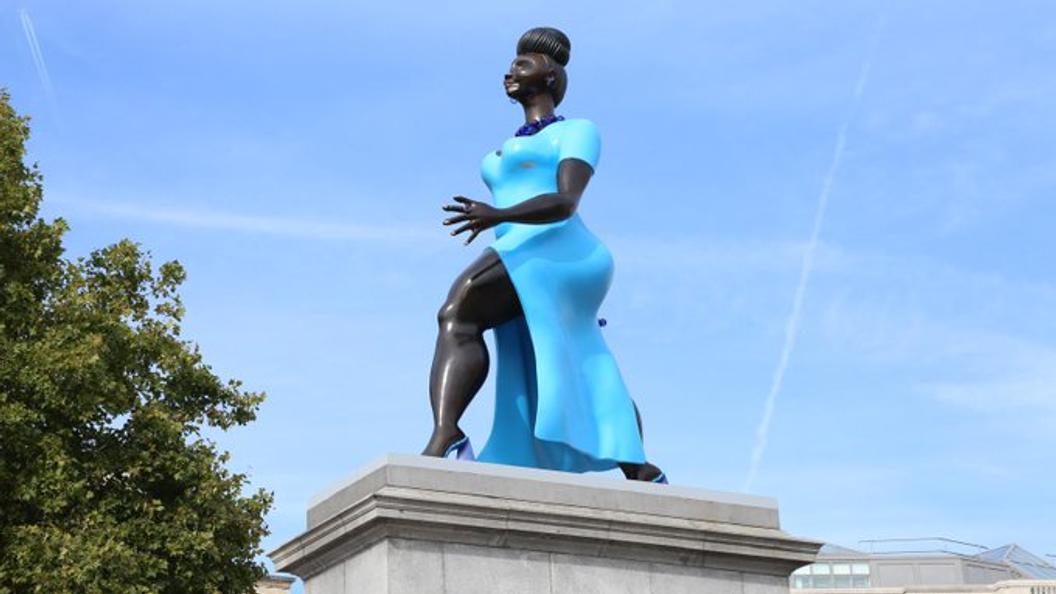
Photographs can be cruel. A bad angle can turn even the most graceful curve into a leaden lump. So it has proved with Lady in Blue, the latest occupant of Trafalgar Square’s Fourth Plinth. In pictures, Tschabalala Self’s giant bronze striding woman looks like a crude, tacky commission. In the flesh it is a fair piece of public art. More importantly, Self has fulfilled the Fourth Plinth’s unofficial brief: needling reactionaries, flattering progressives and giving writers work.
The response has been entirely predictable. Telegraph literary editor Cal Revely-Calder complained “this figure has little to give” and compared the oversized limbs to Corporate Memphis, the bland illustration style most often seen in NHS leaflets. Jonathan Jones, the Guardian’s art correspondent, claimed to have been swept away: the unveiling hit him “like a thunder clap” and gushed that the generous proportions might stop traffic,
These polarised reactions reflect the cultural seepage of the omnicause, turning the enjoyment of art into a political purity test.
It is undeniable that this striding “everywoman” follows some truly monstrous ideological commissions, most recently Teresa Margolles’s cube of 726 pseudo-death masks of “trans and nonbinary” people. And the official blurb for Lady in Blue ticks much the same DEI boxes. With all the passion of an HR team on a diversity away day, the work is hailed on the london.gov website as “a symbol of our shared present and future ambitions”, aspiring to “equity through representation, recognition, and action” in a world where “all global citizens are appreciated for their unique contributions”.
Yet, despite the obvious regime-approved sentiments, I can’t help but like Lady in Blue
This is the sort of blandly sinister spiel that makes me want to crawl into a bunker with a crate of tins and wait for the last flicker of civilisation to blink out. Yet, despite the obvious regime-approved sentiments, I can’t help but like Lady in Blue. I do not love her, but politics aside, she is undeniably joyful.
Lady in Blue is carefully named. She is not merely a woman: she is respected. Jewellery gleaming and glammed up for a night out, this giantess is plainly in charge. That might sound frivolous, but a woman’s freedom to earn her own money, dress as she pleases and enjoy her independence is worth celebrating. Step back in time, or look beyond Britain, and such ordinary liberties are anything but ordinary.
The curvaceous figure brings to mind Birmingham’s “Floozie in the Jacuzzi”. Dhruva Mistry’s The River, unveiled in 1994, divided opinion but soon became both a landmark and a source of civic pride. Perhaps those times were not so different. Britain was then in the grip of complaints that political correctness had gone mad. Though drag queens had yet to take over the BBC or libraries, whether it was renaming black bags or the war on Christmas, establishment lefties were already finding ways to troll the right.
When I reached Trafalgar Square yesterday, Lady in Blue had competition. In front of her, black British evangelicals held a revival. To one side, men handed out copies of the Qur’an; to another, Iranian dissidents tried to make baffled tourists care about Iran. A troupe of toothsome, if not terribly talented, young women performed in skimpy clothes as goggle-eyed men stared. A man sang badly to a backing track, while Falun Gong members explained the Chinese state’s persecution of their movement. In that frenetic setting Lady in Blue makes sense.
The blue glaze makes her seem less like a work of art than a very expensive public-realm mascot
For my taste, the blue glaze makes her seem less like a work of art than a very expensive public-realm mascot. But the huge forward leg and swinging gait give her a proper relationship with the plinth. She appears caught mid-stride, not simply lowered on to it by a crane. That sense of movement makes her more immediately relatable to the tourists and Londoners bustling through Trafalgar Square than the great men surrounding her.
Unlike the rapturous reviewers in the left-wing press, I did not fall in love. But Lady in Blue is neither proof of inevitable cultural decline nor an ugly woke monument to be endured until the next commission. She is an agreeable, slightly over-designed woman taking a purposeful stomp through a square that has always accommodated spectacle, argument and humour. And though might not like where Lady in Blue is going, there’s no stopping her.
With thanks to The Critic, where this was first published on 20th September 2026.