For Women Scotland on sex, slander and success
They took on the Scottish establishment, endured years of smears and won a historic Supreme Court victory. In the wake of their most recent victory against the Scottish government, For Women Scotland share how they did it.
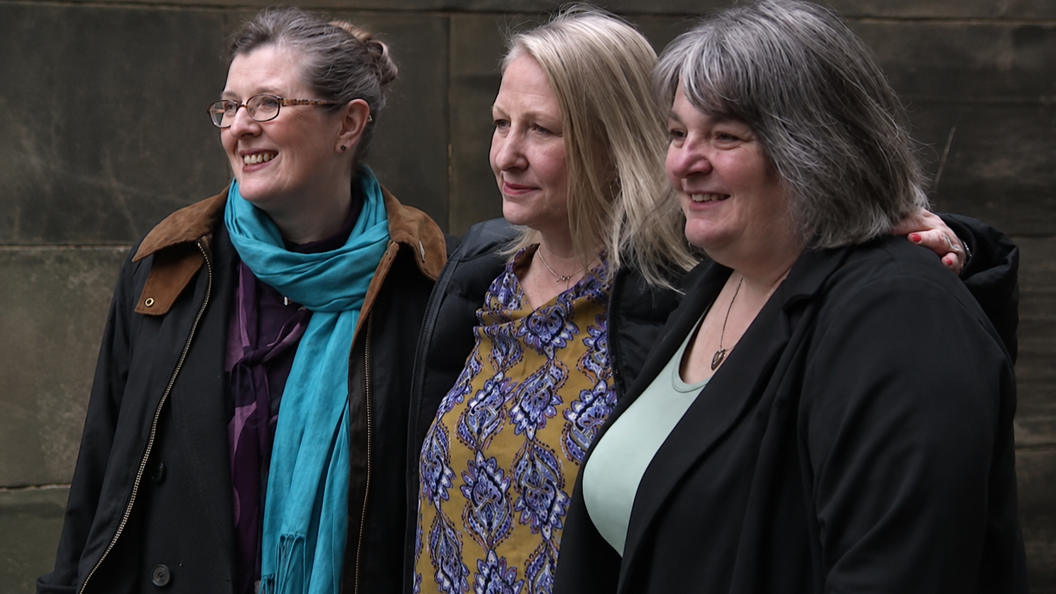
Potato the cat jumps onto Marion Calder’s lap, presenting herself for adoration. The cuddly white feline belonged to the much-missed Magdalen Berns, who helped found For Women Scotland (FWS) before her death in 2019. Susan Smith and I coo obligingly while sipping cups of tea from behind our respective screens. Fellow founder Trina Budge is absent, looking after the cows on her Highland farm. For an organisation routinely cast as part of a sinister international conspiracy, the people behind For Women Scotland are remarkably down-to-earth.
Mumsnet was where this shadowy cell first assembled. “Quite late one night, I got this message from Trina saying, ‘Hello, I saw your post some months ago. Would you like to be part of this Scottish organisation we’re trying to set up?’” Smith tells me. “I was so excited. It was like being recruited.
“We’d all got false names. Trina had one name on Mumsnet, a different name when she contacted me on Facebook, and then a completely different real name.” Says Calder.
This was nearly a decade ago, a time before terms such as ‘gender critical’, ‘sex realist’ and even ‘single-sex spaces’ were in common parlance. When even the merest suspicion of transphobia could end a career and sever friendships.
None of the women were seasoned political operatives. Busy with work and raising children, Calder and Smith had assumed that once people in authority understood what trans activists were trying to do, common sense would reassert itself.
“Our generation were children when second-wave feminism was coming through in the 1970s,” Smith says. “We weren’t really aware of it happening. Then we grew up and things seemed to be moving in the right direction. You just assumed women’s rights would keep improving.”
We realised the cavalry weren’t coming. We were going to have to do something ourselves.
Their rude awakening was discovering how fragile the gains of the women’s movement were. Calder recalls being troubled by the 2016 Rio Olympics, where athletes with differences of sex development swept the podium in the women’s 800 metres. Meanwhile Smith remembers her incredulity when Olympian Bruce Jenner declared himself Caitlyn, was named Glamour magazine’s ‘Woman of the Year’ and then complained that “the hardest part of being a woman” was choosing what to wear.
“I think a lot of women got a real shock when they realised rights aren’t on some constant upward trajectory,” Smith says. “They can actually be rolled back remarkably easily.”
At first, they assumed the growing conflict between reality and transgender ideology would either burn itself out or that someone with authority would intervene.
“Marion kept saying, ‘Where are all these professionals? Where have they gone? They must know,’” Smith recalls.
It turned out many of them did.
“We discovered quite quickly that people in the women’s sector knew exactly what was happening. They got in touch with us and told us things that certainly informed what we were doing. But they were frightened to speak publicly because they thought they’d lose their funding or their jobs. At that point, the Scottish Government was telling organisations they had to be trans-inclusive or they wouldn’t get funding.”
The awakening was sobering. “We realised the cavalry weren’t coming,” says Calder. “We were going to have to do something ourselves.”
And so the four women embarked on a legal campaign that would eventually have seismic ramifications for women’s rights across Britain. Yet it began with something remarkably small: a few words buried in a relatively obscure piece of Scottish legislation.
Smith tells me it was Budge, whom she describes as a “demon for detail”, who spotted the problem in the Gender Representation on Public Boards (Scotland) Act 2018. Section 2 defined “woman” as including someone with the protected characteristic of gender reassignment who was “living as a woman” and proposing to undergo, undergoing or having undergone a process “for the purpose of becoming female”.
FWS challenged the definition and won. In 2022, the Court of Session ruled that it strayed into equal opportunities law reserved to Westminster and was therefore outside the Scottish Parliament’s legislative competence.
But that victory saw a battle open on another front. The Scottish Government issued fresh guidance stating that a man with a Gender Recognition Certificate recognising him as female should count as a woman under the Act. FWS went back to court and this time lost. Twice. Smith admits that the defeats frightened her.
“I kept panicking. I don’t think Trina ever thought of giving up. I’m not sure Marion did either. But it was quite scary at points, especially when women kept losing.
“We knew that if they won and we had to pay costs, that could have been the end of For Women Scotland.”
Nevertheless, they persisted. By November 2024, what had begun as a dispute over appointments to Scottish public boards had become a question with implications for every British citizen. The Supreme Court had to settle what “man”, “woman” and “sex” actually mean in the Equality Act.
Now feminism has become a career. You have professional feminists who’ve never had to do that hard graft themselves, and they don’t understand that other women still do.
“When we first started, because we hadn’t been going very long, it almost didn’t matter. We thought, ‘Well, we’ll just start over.’ Says Smith.
“But by the time we got to the Supreme Court, we’d built up such a brand, with name recognition and a reputation, that it was quite difficult to think about what the cost might be if we lost and had to give up the organisation.”
On 16 April 2025, FWS won. Pictures of Smith and Calder cheering outside the court made front pages across the UK as the Supreme Court unanimously ruled that “sex” in the Equality Act means biological sex, overturning the decisions of the Scottish courts below.
It is extraordinary to think how easily women’s legal rights might have been lost. Protections across the United Kingdom ultimately hinged on a few lines in a niche Scottish public-boards law, Budge being astute enough to spot them and FWS tenacious enough to keep fighting after defeat. In the months since their Supreme Court victory, FWS has been back in court, this time to defend sex-segregated prisons in Scotland. Again, the Scottish Government fought them. Again, the women won.
Yet victory has done little to soften the hostility towards them. Opposition has come not only from zealots in Holyrood and their trans activist allies, but from government-funded third-sector organisations. Calder and Smith are particularly scathing about the professional class of feminists who suck at the government’s teats.
“They’ve forgotten how groups like theirs started,” says Calder. “Grassroots women giving up their time for free. Now feminism has become a career. You have professional feminists who’ve never had to do that hard graft themselves, and they don’t understand that other women still do.”
Smith agrees. “There’s this widespread belief that people don’t do things simply because they believe in them. They assume everyone expects some sort of reward.
“Rape crisis centres were originally set up by ordinary women. They weren’t a job opportunity. Now, frankly, a lot of these organisations offer a career path. In Scotland especially, getting onto the right boards can be a route up the political tree. You get on the escalator and ride it to the top.”
Both are bloody furious about Amnesty International UK, which recently included FWS alongside other grassroots women’s organisations in a report on what it called Britain’s “anti-rights ecosystem”.
“We got hold of the agenda for a meeting of third-sector groups. These were extremely well-funded outfits, including Amnesty, with salaried staff who move between different organisations in the charity world,” Smith tells me.
“In a way, I can understand their confusion. They’re sitting in a room with all these big organisations and funders, and nobody is saying, ‘Yes, we fund For Women Scotland,’ or ‘We fund Sex Matters.’ So they think, ‘Well, who the hell does?’”
The answer, of course, is neither the Kremlin nor the Alliance Defending Freedom. It’s largely ordinary people, mostly women, donating their own money and giving their time for free. But neither truth nor the passage of time have stopped the smears. Calder explains:
“You’ve got trans activists who just lie. But then you’ve also got newspapers and organisations like Amnesty and parts of the women’s sector just coming out with this conspiratorial stuff.”
In 2021, a For Women Scotland post condemning the Taliban’s persecution of people on the basis of sex was recast as support for the misogynist regime. Heather Herbert, then LGBT+ Labour Scotland’s trans officer, accused FWS of “cheering the Taliban on”, a claim duly reported by Hannah Brown in The Scotsman.
Even after their Supreme Court victory, Smith says, FWS struggled to get onto the BBC’s flagship programmes. It took listeners lobbying Woman’s Hour before they were invited on, where they received a sub-zero reception from the presenter.
Calder thinks a “hostile interview can be better than an easy ride. If you’re challenged and can give reasoned answers, that probably looks better to the wider public.”
You can’t really trust each other until you’ve seen the whites of each other’s eyes
What rankles is the double standard over who is deemed respectable enough to be heard.
“Look at some of the people from the other side who’ve been interviewed on BBC programmes. Men who say genuinely appalling things about women, reducing them to sexual objects, are apparently respectable enough to be given a platform.”
Here, Smith might be thinking of previous Woman’s Hour guests such as Berkeley professor Grace Lavery, who discussed his memoir Please Miss: A Heartbreaking Work of Staggering Penis despite having posted a photograph of himself with his fist in his partner’s mouth; India Willoughby, invited to expound on women’s unshaven legs; or boxing promoter Kellie Maloney, who has admitted trying to strangle his then-wife. All, of course, identify as transgender.
But perhaps being kept outside respectable circles has been part of FWS’s strength. With no institutions to placate or careers to protect, they could concentrate on winning. Asked what made their campaigning so successful, Smith’s answer is strategic.
“We’ve been good at finding the weak points. I would say to other campaigners: don’t spread yourself too widely. A lot make that mistake. They try to fight everything at once and end up without a clear voice or a clear idea of what they’re trying to achieve.”
For FWS, that meant resisting the temptation to become a campaign about everything. They spoke up on other battles but concentrated their fire where it could make a difference.
In the early days, that meant rallies outside Holyrood. “You can’t really trust each other until you’ve seen the whites of each other’s eyes,” says Smith.
Those gatherings became a recruiting ground. Women brought professional expertise and spun off into other projects.
Their opponents inadvertently helped too. “To an extent, the Scottish Government did us a big favour by passing such bad legislation,” says Smith. “Scotland was in a worse position than the rest of the UK. But when things are worse, you have more to push back against, and if you win those battles, the impact is greater.”
Why Scotland, birthplace of the Enlightenment, fell quite so hard for an ideology based on gendered souls is a question that still exercises them. Calder and Smith see its small, tightly connected political and third-sector world as particularly susceptible to lobbying. But they also blame former first minister Nicola Sturgeon.
Smith believes gender self-identification offered her a cause of her own after years in Alex Salmond’s shadow. “I think she saw it as a way of creating a legacy and securing the loyalty of younger activists. But as time went on, she became almost evangelical about it.”
We’d happily chat with the Greens if they’d agree to speak to us
Opposition only seemed to harden her resolve. “There were a lot of very clever women, including women in her own party, telling her she was wrong,” says Calder. “Instead of listening, she became a bit late-era Thatcher: ‘I’ve got my idea, I’m not letting go, I have to be right.’” By the time the issue reached Holyrood, Calder remembers Sturgeon sitting with her back to the protesting women in the public gallery. “She never looked at any of us.”
FWS, by contrast, has been careful to remain politically non-aligned, no small feat in a country where independence remains a rumbling faultline. Its supporters range from committed nationalists to staunch unionists.
“Working across political lines is something we’ve always prided ourselves on,” says Smith. “We work with groups within the mainstream parties, and even the communists turn up every time we have an outdoor rally with their enormous banner. We’d happily chat with the Greens if they’d agree to speak to us.”
But winning the argument over the legal definition of a woman has led Calder and Smith to something larger. What increasingly preoccupies them is safeguarding, and what they see as an institutional habit of dissolving boundaries.
Scotland has some grim history here. Ian Dunn, the gay-rights campaigner who founded the Scottish Minorities Group, also co-founded the Paedophile Information Exchange in Scotland in 1974. Decades later, James Rennie, a former chief executive of LGBT Youth Scotland, was convicted of serious child sexual offences. What troubles Calder is not simply that abusers existed, but what she sees as an institutional reluctance to turn the searchlight inwards.
“After Rennie, you would have thought the organisation would want a proper investigation, if only to establish that nothing else had been going on,” she says. “But that never happened. Scotland is small, and perhaps there’s a tendency not to look too closely under the bonnet.”
That history informs their unease about the erosion of boundaries between adults and children.
Who is actually being beaten up in the home? Who is being sexually assaulted? Who needs protecting? Those should be the basic questions.
“We used to warn children about stranger danger,” says Smith. “Now nobody even seems to want to call them children. They’re ‘young people’. We’ve developed this idea that children have complete bodily autonomy, that young people know best and adults simply have to listen.”
Calder is emphatic. “I’m sorry, but no. Children do not always know what is best for themselves. That’s one of the reasons adults have safeguarding responsibilities in the first place.”
To them, the contradictions are everywhere. Under the UN Convention on the Rights of the Child, now incorporated into Scottish law, anyone under 18 is a child. Yet 16-year-olds can vote. This is not just theoretical; girls from Scotland who identify as trans have been referred for mastectomies in England at 16.
“If a surgeon wouldn’t have performed that operation on an English girl of the same age, why was it acceptable because the girl came from Scotland?” asks Smith. “Where on earth was the safeguarding?”
It is the question they keep returning to, whether discussing children, women in prisons, psychiatric patients or intimate healthcare. Beneath apparently disparate campaigns, Calder and Smith see the same failure: institutions becoming so preoccupied with accommodating trans-identified people because they claim to be vulnerable that they stop asking who is actually at risk.
“That’s what we’ve consistently pushed for: safeguarding,” says Calder. “Who is actually being beaten up in the home? Who is being sexually assaulted? Who needs protecting? Those should be the basic questions.”
It is here that any sense of triumph over the Supreme Court victory ebbs away. Both women become distressed when talking about those least able to fight for themselves. They reel off accounts from NHS staff, patients and relatives: men placed on female hospital wards; vulnerable patients expected to accept male carers in their homes; and male psychiatric patients placed alongside severely distressed women, who are then gaslit and berated for calling them men.
The NHS doesn’t exist for staff. It exists for patients
“These are some of the most vulnerable women imaginable,” says Calder. “Some may not even be particularly verbal. They have asked for female care, or their families have asked for it, and a man turns up.”
Smith is equally incensed by the unions. “They would represent someone accused of genuinely racist or homophobic behaviour, because that’s what unions are supposed to do. Yet when a member says you can’t change sex, suddenly it’s, ‘Oh gosh, we can’t touch that.’”
For Smith, the principle could hardly be simpler. “The NHS doesn’t exist for staff. It exists for patients. They’ve been worrying about toilets and changing rooms and they’ve missed the blindingly obvious: what happens to the patient?”
FWS is now gathering accounts from patients and their families. “So we’re going to go after them,” Calder says. “This isn’t just a civil matter. It could be criminal.”
The Supreme Court settled a significant legal question. But it did not undo the policies, practices and assumptions built up while activists were funded to take over institutions. After years chipping away at the law, Calder and Smith have come to realise that the ideological war is still raging.
“The litigation was almost the straightforward bit,” says Smith. “Unpicking everything that has grown up around this is going to take much longer. It’s like knotweed. You pull at one bit and discover how far the roots have spread.”
Please note the quote “Marion kept saying, ‘Where are all these professionals? Where have they gone? They must know,’” was inaccurately attributed to Calder in an earlier version of this article.