Stop making excuses for exhibitionism
How the internet fuels inappropriate attention-seeking behaviour, and how EDI enables it. This article was first published in The Critic
Lecturer Matt Rattley was anxiously anticipating meeting his new students at Oxford when he posted on LinkedIn: “Politely ignore the double eye bags please and thank you, courtesy of a 9am class…” But no one, not one person, would have noticed the space under his eyes. Anyone who saw the photograph would instead have found themselves gawping in horror at the enormous prosthetic breasts beneath his skintight maroon T-shirt.
Reports of the cross-dressing biochemist, who also offers private tutoring to A-level and GCSE students, first surfaced earlier this year. Despite criticism from Oxford dons and excoriating press coverage, Rattley has been allowed to keep wearing an oversized rubber rack while teaching undergraduates.
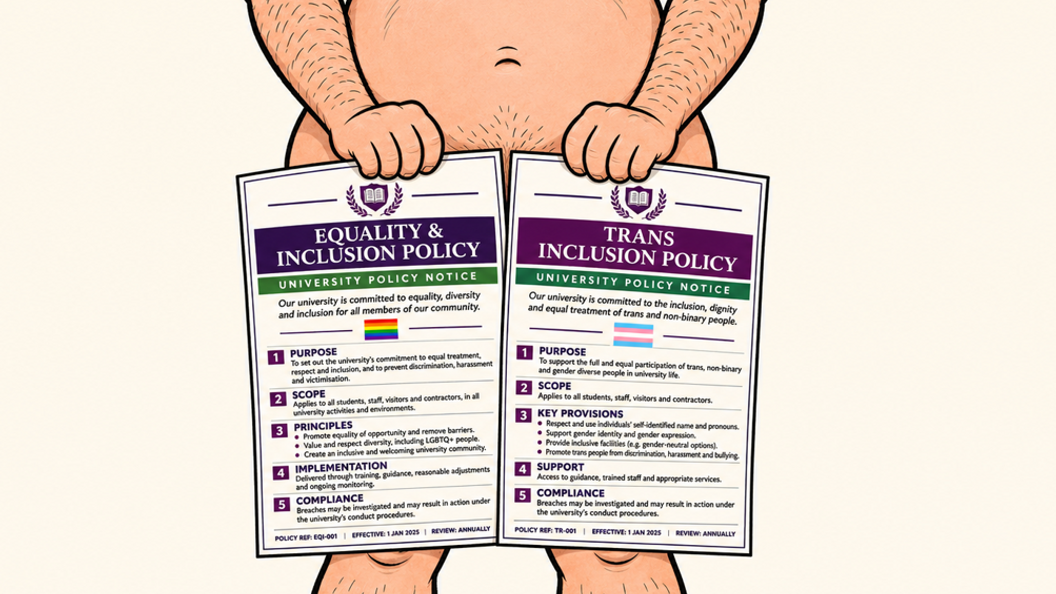
When questioned, the university drearily reaffirmed its commitment to “being an inclusive and welcoming place where all members of our community feel respected, valued and able to be themselves”. How welcoming it must be for the eighteen-year-old women in Rattley’s classes went unmentioned. The spokesperson added that the university “does not comment on individual personnel matters”.
Yet this is part of a much broader pattern: exhibitionists exploiting workplace anti-discrimination policies to excuse their peccadilloes. Tellingly, Rattley uses they/them pronouns on LinkedIn, and complements his fulsome beard with red lipstick and nail varnish. One can imagine the watercooler conversations in Oxford’s Equality, Diversity and Inclusion and Human Resources teams. If a man’s comically large moobs are part of his “true and authentic self”, does the university’s “bring your whole self to work” mantra require everyone else to smile along?
Why, decades after women fought to rid factories of nude calendars and offices of Page Three pin-ups, are institutions still so reluctant to tell employees that overtly sexual displays, whether pornography or plastic breasts, are unacceptable?
Rattley is not an isolated case. On Friday, The Telegraph reported that an Ontario school-bus driver, identified only as LZ, was removed from a school route after a video showed him in a revealing pink uniform beside a sign naming the bus “the Lolita line”. The driver later filed a human-rights complaint alleging discrimination. Canada, known to its critics as Tranada, is a world leader in these matters. In Ontario, woodwork teacher Kayla Lemieux made headlines a couple of years ago after he was photographed going to work in a boob suit, with fake breasts so gargantuan they must have posed a health and safety hazard in the workshop.
This is a social problem before it is a legal one. Once, a man who arrived at work in fetishwear would, at the very least, have been told to go home and get changed. Today, such boundaries have melted away, replaced with veneration of ‘brave’ cross-dressers, from drag queens to the trans-identifying men routinely celebrated on cheesy lists of inspirational women.
Of course, some conservatives will point the finger at women entering workplaces. The argument goes that our apparently naturally nurturing behaviour has meant feelings are put before hard boundaries. But there’s a more obvious social change at play: pornography. According to YouGov around a third of men (36%) say they watch pornography at least once a week, including 13% who watch porn every day or most days. It is, of course, easier for some commentators to wang on about the ‘great feminisation’ and blame Mummy than it is to confront what is the most significant change in human sexual behaviour since our species came down from the trees.
Pornography works like any other type of business in the attention economy. Users must be kept on screen, scrolling, clicking and generating data. To do that they are supplied with ever more niche and bizarre material, effectively monetising boundary violation. Whether shemale porn or humiliation rituals set by online dominatrices, some heavy users of pornography treat the real world merely as a backdrop to their fantasies. It is no surprise that bizarre, highly sexualised behaviours are emerging among the first generation to grow up with unfettered access to hardcore pornography – and no one has the gumption to tell them No.
Once, in the time before the digital revolution, creepy blokes could be mocked, and a little ridicule does a lot to keep social boundaries in place. But today, staff LGBTQ networks have workplaces by the short and curlies. Staff are urged not to judge, and to defer to the lived experience of vulnerable minorities. And the ‘vulnerable minorities’ themselves, brought up with pornography shaping their sense of self, often believe they are entitled to protection. The silence of colleagues and managers may be cowardly, but given the pressure to comply, it is understandable.
Today, there is a grisly symbiosis between equality, diversity and inclusion and pornography. In the workplace, inclusion policies exist as a fetish-laundering service. It seems inevitable that in the years to come we will see more exhibitionists who insist on bringing their full(some) selves to work.