
Shaken but still singing
This is a first-person account of what happened on the evening of Saturday 7th November 2026, as women assembled to hold a peaceful Reclaim the Night in Nottingham city centre
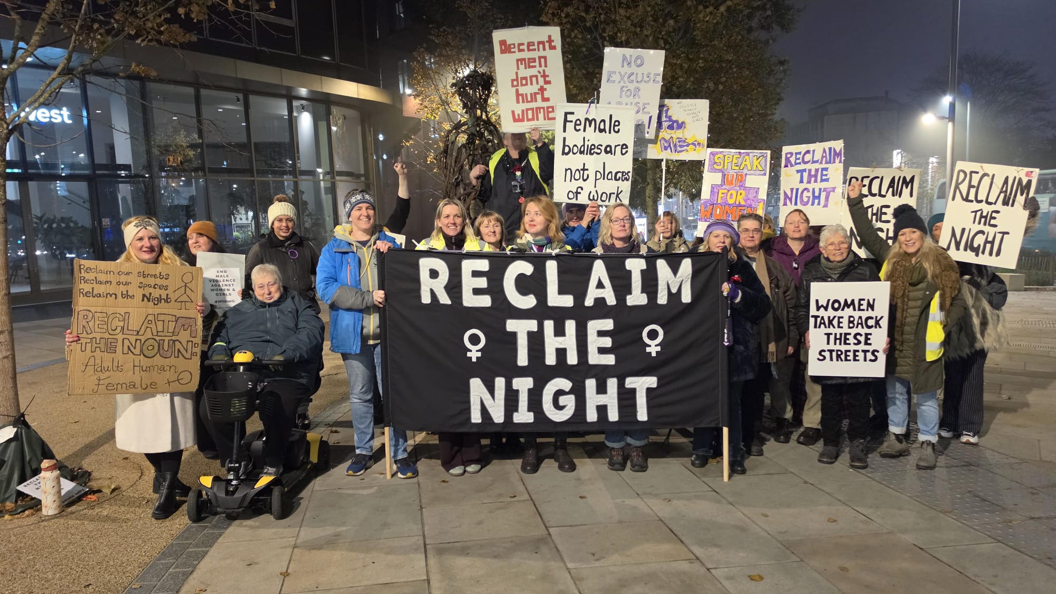
I wanted to write this while the events are still fresh, because it was a historic moment. We believe this was the first explicitly female-only Reclaim the Night in Nottingham for at least a decade, if not 15 years.
On the chaos
We all met in a pub beforehand, just around the corner from our assembly point, for a little dutch courage. Myself and another steward immediately began liaising with the police. There was one police car, one van and around ten officers dotted around the area where we were assembling.
We knew the protestors were coming: they’d advertised their plans on TikTok. They were prompt, if nothing else. Many were associated with the Revolutionary Communist Group/ Fight Racism! Fight Imperialism! (the “omnicause-istas” from here on). They quickly assembled and began intoning their magical incantation, “Trans rights are human rights”, while waving Palestinian, Cuban and Antifa flags.
You might have seen the footage by now. There are two videos; the first captures the chaotic confrontation between police officers and the tin-pot ‘revolutionaries’ baying for us women.You can hear one of our group, her voice shaking with panic, saying: “This isn’t safe. We need to get in a shop or a pub.” Police sirens blare in the background. The scene is bedlam, and that’s precisely what it felt like witnessing it in real time. I’m out of shot in a state of hypervigilance, making sure the women are sticking together. We huddle together for our own safety.
Contrast that with the second video. By this point, the police had held back the omnicause-istas and escorted us along an alternative route. We could breathe again. And sing. Three officers led us towards the finish at the Maid Marian statue, in case any rogue ‘revolutionaries’ appeared unexpectedly.
A final picture shows us arrived, safely, at our intended destination. We’d got through: shaken but singing, we had reclaimed the night in Nottingham for women.
On the protestors
Reviewing footage from women’s phones and bodycams, and photographs of the omnicause-istas, a few things stand out.
Most appeared young. The group included a sizeable contingent of student age women, militant men eager for a scrap with police, and a smattering of trans activists. Its flags and causes suggested a loose alliance of political and identity-based campaigns, seemingly united by grievance.
I struggle to identify any coherent philosophy underpinning what we witnessed. My best guess is that these are simply angry toddlers in adult bodies, raised on a calorie-rich diet of identity politics and victimhood as virtue, who need someone to scream at. When they encounter women standing together and saying No, it challenges the very foundations of their worldview. They see that worldview crumbling, and it terrifies them. Whatever their individual motives, their behaviour amounted to unjustifiable intimidation and harassment of women peacefully exercising our right to assemble.
There was another interesting illustration of male aggression later in the evening. Having arrived at an open square, we stopped to deliver some speeches (more on those below). One woman’s speech about pornography prompted a chorus of drunken, lairy yobs to shout, “We love porn!” They barked at us like rabid dogs. The hostility towards a female-only gathering was another display of male aggression and entitlement, and a reminder of why we need Reclaim the Night as a rallying call for women’s safety.
On the police
Now, the police deserve credit for their work on the night. We worked with two sergeants throughout the evening. They were approachable and seemed to understand our concerns. They did initially encourage us to reroute, but we stood firm: we’d publicised the route and chosen it with accessibility in mind. Some women in our group used wheelchairs or walking sticks, and we wanted to stick to the planned route.
The police agreed to escort us, with officers stationed along the way. We believe they hadn’t anticipated the scale of the confrontation that unfolded. Sadly, we had.
You could see the police’s assessment of the situation changing in real time. As a line of omnicause-istas began forming a human chain, officers were desperately attempting to separate them so that we could pass. I could see the panic in their eyes. The police themselves seemed taken aback by the speed and intensity with which the situation escalated.
Our women, however, have long memories. Nottinghamshire Police do not have an unblemished track record when it comes to keeping women safe, and some of our group felt that the response on the night was underprepared and, at times, flustered. Some women drew comparisons between the policing of our small, vulnerable group and the kind of robust policing routinely deployed around rival football supporters, often overwhelmingly male.
It was genuinely terrifying. We had survivors of domestic abuse and sexual assault among our group that night. To have aggressive men behaving in this way, at such close quarters, was deeply distressing and, for some, traumatic.
The police ultimately listened to our concerns and acted, and for that we are grateful. But we felt the response was not quick enough, and the initial lack of preparedness left women feeling exposed. Both things can be true at once.
On the speeches
For all the chaos and hostility surrounding us, the speeches were a reminder of why we had assembled.
Our opening speaker reaffirmed the fundamental right of women to use public spaces without fear of harassment, intimidation or violence at any time of the day or night. She stood her ground, with visible harassment taking place just a few hundred yards away, and delivered these powerful words:
“We are here to make our message visible, unmistakable and impossible to ignore.”
After moving away from the baying mob, we stopped halfway along our route for further speeches. Another member of our contingent gave a clear reminder of who we are and why we stand together:
“We are women. Every single human being on this planet is born from a woman. We are your mothers, daughters, sisters, aunties, nieces, granddaughters, grandmothers. We are women.”
She drew on her own experiences of domestic abuse, speaking about how it is so often the men closest to us who are responsible: “our fathers, boyfriends, partners, husbands, brothers and uncles” rather than strangers lurking in dark alleys. She also spoke powerfully about the role of pornography in normalising and perpetuating violence against women and girls.
Our next speaker took us back to why we still march today, almost fifty years after the horrifying spate of murders in Yorkshire in 1977, when women were told by the police to stay indoors after dark. As she reminded us, this response “[restricted] women’s lives instead of confronting the problem – male violence. In effect, they placed a curfew on women while men were allowed to roam free.”
We remembered the brave women of the Leeds Revolutionary Feminist Group who took to the streets, torches in hand, and refused to accept that women should be confined to their homes because of male violence: “The streets belong to women too, and we will not disappear from the public space because of male violence.”
Our final speaker was a local woman in her eighties, a survivor of domestic abuse and one of the women involved in establishing Nottingham’s first Women’s Aid refuge. Her short speech speaks for itself:
“When I had healed a bit I went to work for Women’s Aid in Nottingham and we set up the first refuge in Nottingham. And it was quite hectic. The women in those days had no help, no counselling, no therapy. Just us and ourselves. And how did they do it? They supported each other and didn’t quit. So we will support each other and we will not quit!”
Cue rapturous applause and tears in all our eyes. There was something rather wonderful about hearing those words from a woman who had been part of that history and who continues to stand alongside other women today.
In the final few moments, as we made our way towards the Maid Marian statue, we sang and chanted.
Women unite
Reclaim the night
Women unite, Reclaim the night
In every town and every nation
Women unite, Reclaim the night
Power to the Women,
Women got the Power
Sisters can you hear us?
We’re stronger by the hour
Power!
Power!
We were a small band of women. We’d assembled together, stood together and marched together. After the hostility and intimidation of the earlier part of the evening, we couldn’t have asked for a better way to finish it all.
There was one moment that I’ll never forget from that night. A young girl, no more than 18 or 19, arrived at the assembly point with her mother. She couldn’t understand the motivations of the protestors - “this is a march for women, what are they protesting?” 15 minutes later, we’re marching through hell. Myself and her mother are flanking her, rubbing her shoulders to keep her close as she visibly shakes, cries, and covers her face with a scarf. Not a face covering just for anonymity, but because she wanted to make herself physically smaller, to disappear, to shut out what was happening around her. As we walked through the hostility, she sobbed. By the halfway point, she sang alongside us. By the end, she thanked us for keeping her safe.
That, for me, made every hour of planning, every difficult conversation and every bit of hard work worthwhile. We’d created a space where a young woman could go from feeling frightened, clinging to her mother, to feeling empowered.
On the future of RTN Nottingam
Since the march, prominent figures in the women’s rights and free speech movements have publicly backed us. The optics for the Revolutionary Communist Group and others involved in the protest are, to put it mildly, abysmal. Even voices on the broader left have condemned the behaviour, including The Heartlands Tribune, a self-described “independent left-wing news, analysis and opinions” outlet. We’re grateful to everyone who has spoken out in our support.
We’ve also been in touch with the police, who are working with us to improve coordination and protections for women when concerns about protest activity arise.
Nottingham RTN, and TERF Times, have both requested a comment from Nadia Whittome MP, who represents Nottingham East. She has remained offensively silent.
Ultimately, what happened on 7th November demonstrated that we are strong. We are one. We are women.
Obviously, we’ll be back for 2027 - bigger and louder than 2026.