
Never Mind the Backlash, Here's Ali Morris
Pink-haired, pint-sized and provocative, Ali Morris talks to TERF Times about standing out and standing up for women
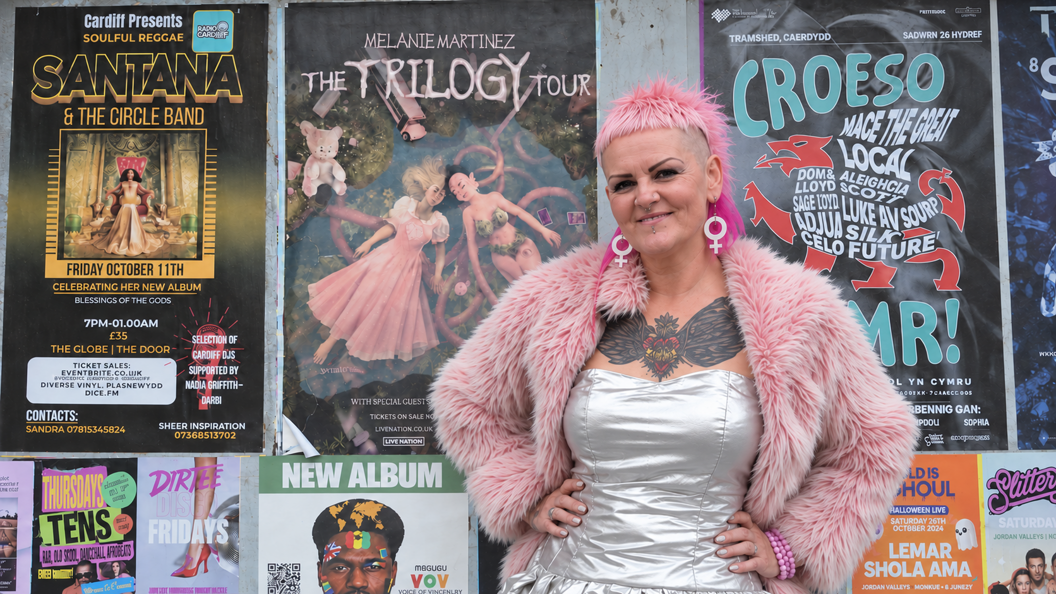
“Oh, I love your earrings,” giggles the awestruck young woman at the till in the department store café where Ali Morris and I meet. Morris, perhaps Wales’ most notorious radical feminist, smiles and bats a compliment back; within seconds, the pair are chatting as if they have known one another for years.
At 4’10”, the 60-year-old pink-haired punk is quite literally on my level. But while I tend to skirt around the seams of social situations, dodging errant elbows, Morris has a look and a presence that command attention. And she puts it to good use, unafraid to stand out, or indeed stand up when she thinks something is wrong.
Within moments of sitting down, she tells me: “I don’t mind speaking plainly. I don’t mind conflict. I don’t mind having the argument that others are too shy to have.”
Her latest endeavour, co-founding Feminists Against Antisemitism, grew from a painful split with FiLiA, the feminist charity with which she had volunteered for years.
“After 7 October, I expected a feminist organisation to be unequivocal. Hamas had committed atrocities against Israeli women and girls, and they deserved our solidarity. Instead, there was reluctance to condemn what had happened.”
The fuse was lit at FiLiA’s 2025 Brighton conference when, at the opening plenary, Rahila Gupta, chair of Southall Black Sisters, led a chant of “Free Palestine” from the stage. The row later spilled into the conference disco, where a confrontation erupted after a delegate unfurled a Palestinian flag.
More disturbing still was literature distributed by Total Woman Victory, a US Marxist feminist group, which stated: “When you cut open an occupying Zionist soldier, a fragile Nazi general bleeds.” One of its founders, Sathi Patel, has posted in support of Hamas, yet FiLiA invited her to address delegates as part of a panel.
A week later, FiLiA published a statement saying it would investigate the incidents and refer itself to the Charity Commission. The organisation said it rejected racism, religious fundamentalism and extremism, including Hamas, but offered no specific apology to Jewish delegates.
For Morris, the episode reflects a broader problem: parts of the Left regard Zionism not as support for Jewish national self-determination, but as a colonial project.
“What shocked me was that women who could see trans ideology capturing parts of the feminist movement could not see the same process at work in the pro-Palestine movement. You see the same flags, the same activists and the same refusal to look honestly at what is being said and done.
Though not Jewish herself, Morris says she cares about Jewish women “because they are women.” With Freya Papworth, Luba Fein, Josie Stein and Susan McDonnell, she organised an antisemitism event alongside the conference. After several venues refused them, they found one that would, filling a 250-seat room and creating a waiting list. The response led to Feminists Against Antisemitism, now a growing UK-wide group.
It has come at a personal cost; she has been confronted in her home town by furious pro-Palestine activists, and has lost long-standing friends.
“I thought the trans fight was bad, but this is worse. The women who have fallen to the antisemitic brainrot include radical feminists, women I had worked alongside for decades. When we spoke out, the response was not debate but accusations that we were racists and liars, and petty attacks on what clothes I wore.”
The sense Morris gives is not anger so much as disappointment: at the inability of some on the Left to put women before the willy-waving of political factions. But she has never doubted herself. This resolve about right and wrong is something she has held onto since childhood.
She was raised in a sprawling working-class Welsh family in which female strength was everywhere, and female freedom conspicuously absent. Her mother died when she was four, and she was brought up by her grandparents in a house of twelve children. Her aunts had, as she puts it, “seven, eight, nine, ten children” each. Most had little life beyond the home.
“Only the men in my family voted. We weren’t political, but we were all Labour… I remember looking at the tired women around me and thinking, this is not what I want to do. This is not for me.”
Education became her route out. As a child, she would traipse to the library in a nearby town and lose herself in books. She was the first in her family to gain O-levels, A-levels and a university place.
In the mid-1990s, studying for a Welsh degree while raising three young children, Morris walked into Swansea Women’s Centre to volunteer. “I just found my people,” she says. Thirty years on, she is still a trustee.
“I’d never had the chance to talk about my childhood, which was difficult. I always thought the problem was me. At the Women’s Centre, I realised all these other women had complicated lives as well. Nobody had to say anything. It was just understood. Nobody saw you as odd or wrong for it.”
She also found a vocation. “My thing is people,” she says. “Training, workshops, running groups. I found I was quite competent at it, and it gave me a sense of skill and purpose.” By then a single mother, she went on to gain a second degree, train as a social worker and take her first paid job at the Centre.
“What I loved, and still love, is that it was for any woman. You didn’t have to turn up as a medical problem, a mental-health problem or a domestic-abuse problem. You could just be a woman who wanted support… the Women’s Centre was somewhere women were seen for their strengths.”
Having spent most of her working life in female-only settings, Morris is emphatic about their value. “The energy is completely different. The support can be as small as a look across the room, a hand on your shoulder, a cup of tea put in front of you. If you haven’t experienced that in a women-only space, it’s hard to explain how powerful it is.”
Morris’s first encounter with trans ideology came in the early 2000s, when a locally known man arrived at the Centre claiming to be a woman. With no policy in place, he was admitted. It only happened once, but months of meetings and a vote followed. The Centre remained female-only, but the board changed and, Morris says, the place deteriorated. Disheartened, she stepped away for a time.
By the time she returned, Morris had qualified as a social worker. She ran support groups at the Centre while working full-time for Swansea Council. Later, as its violence against women and girls lead, she helped establish a new city-centre domestic abuse women’s hub: a one-stop shop bringing voluntary groups, probation and other agencies together.
But, she says, single-sex provision soon fell out of favour. To retain government funding, the organisation had to admit men.
Now retired, Morris is scathing about a system she believes feeds on women’s vulnerability, reducing them to problems professionals are paid to manage.
The practical knowledge she gained in those women’s groups proved more durable than the institutions themselves. It has also taken her far beyond Wales, most recently to Japan, a country she has come to love.
“FiLiA had funding to send someone to work with feminist groups in Japan, and the chief executive asked whether I fancied going. I thought she meant next year. A month later, I was on my way. If I’d had longer to think about it, I might not have had the courage to go.”
She was terrified. “I knew I was going into a country I didn’t understand.” But the women who received her made sure she was never alone. “They treated me like I was some kind of superstar. I’d walk into a room and it was like Madonna had arrived. They were astonished that a Western feminist had taken the time to come.”
That response reflected the isolation felt by many Japanese feminists. “Japan looks technologically advanced, so people assume it is culturally like a Western country. It isn’t. In terms of women’s rights, it can feel like Britain in the 1950s.”
Morris was wary of arriving as a British woman to tell others how to run their country:
“I was there to share what I knew about building groups: ‘You’ve got this already, so how can we strengthen it? How can we get women working together around it?’ The point was to help women on the ground build their own groups and help themselves.”
She was struck by how deeply embedded the sex industry is. “Women I spoke to, including women who are now professors, had been in prostitution as children. It was so widespread.”
Over several visits, Morris ran workshops on supporting women in prostitution, spoke at universities and worked on relationships and sex education. By her third year, women were asking how to establish groups of their own.
“Consciousness raising is really just women getting together and talking. But women in Japan have to meet privately, sometimes in secret, in houses.”
On one visit, she spoke in the country’s only feminist sex shop, run and staffed by women. “There was no pornography, nothing like that. But it was funny. I’m trying to have a serious discussion with a group of women, surrounded by sex toys.”
The work confirmed what Morris already knew about herself: “I’m very much on the ground. I’m about setting up groups, getting people together. I like being one-to-one with women. Some people are brilliant in the background. I’m the one who’ll be out there.”
Her aim, whether in Swansea or Japan, is not to arrive with a grand plan but to pass on the knowledge and confidence to other women.
“I speak to people where they are, not where I am. Because when you sort out your community, then you can sort out your country. That’s how it works.”
Morris will continue campaigning with Merched Cymru in Wales and Feminists Against Antisemitism across the UK. But she’s equally keen to reach women in Swansea who are put off by the word “feminist”, or who have yet to see that the movement belongs to them.
“I spend a lot of time asking, ‘How do I get more women here, in my own area, involved?’”
“I’ve stuck my hand up for a couple of local heritage projects about the history of women in my area from the early 1800s to now. Suffragettes and Victorian era are my passion, and I already give talks on them across Wales.”
As for the future, Morris believes transgenderism is waning and predicts that antisemitism may, in time, recede. But she expects another poisonous male ideology to take its place.
“We have to get faster at spotting the next thing as it emerges, instead of waiting until it’s embedded. That’s what I hope we’ll be better at in five or ten years: seeing the pattern earlier and saying, “No. We’ve seen this game before.
“Whatever the issue – trans, antisemitism, whatever comes next – it’s always the same story: women and children pay the price. And that’s why we keep going.”