Women march for men
Just days after the discovery of women’s bodies in Northern Ireland, the Men’s Alliance invited women to raise awareness of male victims of domestic abuse
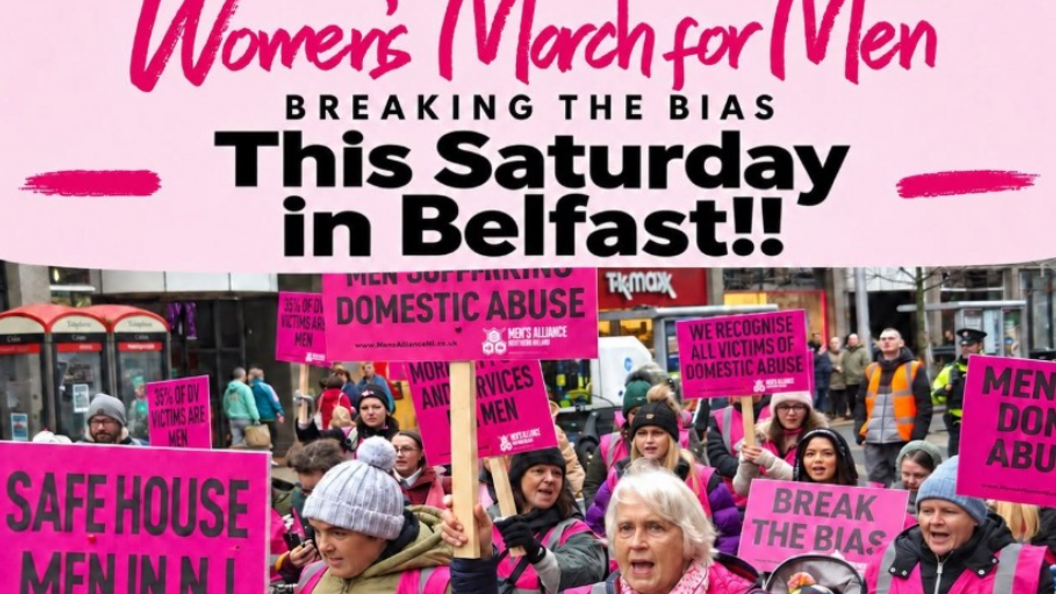
On Saturday afternoon, a crowd of women gathered at Writer’s Square in Belfast in pink hi-vis vests, carrying pink placards and set off through the city centre on behalf of men. Organised by the Men’s Alliance, the Women’s March for Men invited women to walk for the men in their lives: sons, brothers, dads and friends.
Most placards said men suffer domestic abuse too; some said Northern Ireland has no safe house for men. One claimed that alienation from safe, loving fathers causes children lasting psychological harm. The strapline was Breaking the Bias, a phrase lifted from the International Women’s Day campaign of 2022. I assume the organisers thought women had finished with it.
What they marched past
On the Monday before the march, a police officer told Belfast Crown Court how he had found what he suspected were human remains in two bins while searching for Chloe Mitchell, who was 21 when she disappeared in Ballymena in June 2023. A man denies murdering her. The judge discharged the jury without explanation the next day, leaving her family, after more than three years of waiting, to await a new jury expected at month’s end.
That same day, a police search team recovered a body from Lough Erne, and it has since been identified as Carrie Mullane, a 39-year-old mother of four from Limerick who travelled to Enniskillen on 10 October and was not seen again. A man with previous domestic abuse convictions has been charged with her murder and with preventing the lawful burial of her body.
I think of Mary Ward too, because she did what women are always told to do. She was 22 and, in the weeks before she was found dead at her Melrose Street home in October 2024, had reported to police that she was the victim of a violent crime. As it was around Halloween, people assumed the blood on her window was a decoration. A senior police officer said at the time that she was the fourth woman murdered in Northern Ireland in six weeks.
By July of this year, Women’s Aid had counted 30 women killed in Northern Ireland since 2020. Of the 24 who died between 2020 and 2024, 21 were killed in their own homes, and researchers at Queen’s University found that more than half of the women whose cases they could examine were believed to have been strangled. There is a house near where I live where a woman was murdered by her son. I see fresh flowers tied to her driveway gates every time I go past.
Then there is domestic abuse, which is the cause the marchers were walking for. In the year to March, the police recorded 31,558 incidents. The PSNI says it dealt with a domestic abuse report roughly every 17 minutes last year.
An uncomfortable truth underlying these figures is that most men can kill most women with their bare hands. Nonetheless, men are among the victims, and I have no interest in pretending otherwise. Thirty-two per cent of the victims of those recorded crimes were male, which comes to 5,817 crimes with a sanction outcome rate of about 19 per cent. In the same year (2025-26), 91 per cent of the 1,731 people convicted of the domestic abuse offence brought in by the 2021 Act were men, and the PSNI does not publish how many of those 5,817 crimes against men were committed by other men. Some offenders will be men, others women who hit back. Marianne Hester’s study of six years of Northumbria police records found that men committed more abuse, while women were three times as likely to be arrested for each incident.
Outside the home, it isn’t even close. In England and Wales, 93 per cent of the people charged with killing a man in the year to March 2024 were men. A man who has been beaten or controlled by a partner deserves to be believed and to see someone convicted for it.
Who pays for the pink?
Men’s Alliance wanted public attention for male victims, a reasonable aim, but asked women to fill the street, presumably on the principle that if you want something done you ask one. The PSNI managed to run its own campaign for male victims in August without asking women to walk anywhere. It is the only march I know of where the people it was for were not required to attend.
Women run the refuges and answer the helplines; they turn out on a cold November night for their own dead, whatever I think of what that march has become, and then some of them find the energy to put on pink for men as well.
The pink bothers me. It was handed to us as girls to mark what we were supposed to be, and it is bleak to see grown women wearing it as evidence of how good we are to men. The hi-vis is at least practical, since a woman walking through Belfast does well to make herself easy to find.
I want to know who pays for all this pink. Men’s Alliance is a company limited by guarantee, set up in August 2020, whose latest accounts were filed in the smallest category and reported no employees. I found one grant: £10,000 from the National Lottery’s Awards for All scheme in November 2020 for a proposed therapeutic centre for men escaping domestic abuse; its JustGiving page shows fundraisers in the low hundreds. Six years later, the group is lobbying Stormont for a refuge while marchers carry signs saying Northern Ireland has no safe house for men. I could find nothing on who paid for the logoed placards and hi-vis vests, so I will ask: what did the grant deliver, and who paid for Saturday?
Feminism hijacked
I would feel less despairing about Saturday if the women’s events in this city were in better shape. Reclaim the Night started in Leeds in 1977, after West Yorkshire Police, hunting the man we now know as Peter Sutcliffe, the Yorkshire Ripper, advised women to stay indoors after dark, and the women who marched were making a single demand about male violence. They organised without men deliberately, because they had learned that women speak differently when men are in the room, and out of those women-only meetings came the refuges and rape crisis centres we still rely on.
In Belfast, Reclaim the Night is now run by Reclaim the Agenda, a collective of women’s groups, trade unions, LGBTQ+ groups, disability campaigners and human rights organisations. At one recent rally, about 300 people heard speeches on sexual harassment, femicide, racism and discrimination against trans, LGBTQ and migrant people. International Women’s Day draws thousands, with one recent platform featuring peace campaigners from Northern Ireland, Gaza and Afghanistan. Those are serious causes, but I would still like to know how a march founded on one demand about men’s violence came to give that demand a single slot on a long bill.
Men are part of these events now, too. A Belfast councillor publicly called on men, male councillors included, to join Reclaim the Night, and men have spoken from the platform. The march began because men made the streets unsafe for women after dark, and now they get an invitation.
I should say I wouldn’t expect a welcome at either event myself. I am a (proud) terf, and women who think as I do have learned to assume that a march with trans rights on its platform has no place for us. The result is that men are made more welcome at a women’s march in Belfast than women like me.
A group of brilliant, brave Nottingham women tried to restore Reclaim the Night’s original terms this month, advertising a strictly women-only march for 7th November after the usual organisers declined to hold one. They were met by an abusive mob. Marchers say scuffles broke out before the start, the march was repeatedly stopped and police used their bodies to hold protesters back. Women asking for one evening without men needed a police line to get it.
I seldom trust a man who insists on attending a women’s event, whatever he calls himself. When women ask for a space without men and he turns up anyway, he has decided his wishes matter more than their No. “Allyship” is a handy word for ignoring it.
Stormont’s Strategic Framework spells out “Ending Violence Against Women and Girls”, but its 2026 to 2028 Delivery Plan reduces the women to VAWG and EVAWG: all 15 actions use one acronym or the other. EVAWG sounds like something you would take an antihistamine for; it is hard to imagine an online hub stopping a violent man in his tracks. Yet the ministerial foreword opens a strategy with women’s name on it by saying this is not a women’s issue, and two of the framework’s six outcomes are addressed to everyone in society.
The man responsible is much harder to find in these documents. The framework says twice, in its introduction and in its evidence section, that the violence is predominantly carried out by men, and after that he turns into someone at risk of using violence, or simply a perpetrator with no sex attached. The companion Domestic and Sexual Abuse Strategy is described by its own department as ‘gender inclusive’. It is left to the police to say it plainly, in an action plan which records that 36 women and girls were killed by men in Northern Ireland between January 2019 and July 2025.
Invisible men and vanishing women
The famous ones are easy to find, and this month the whole country has been watching them. Russell Brand was sentenced to ten and a half years on the Monday before the march. The judge said his companions may have dismissed his assault on a radio newsreader as “laddish behaviour”.
The next day, ITV and the Guardian published allegations from women who say David Walliams groomed them as teenagers. Walliams denies all wrongdoing. Harvey Weinstein was sentenced to 15 years in New York in September for a 2006 sexual assault; he maintains his innocence. Andrew and Tristan Tate are fighting extradition from Miami to Britain, where they face 59 charges between them. Both deny wrongdoing.
These are the men who will get the court sketches, the timelines and the think pieces, and for a week or two everyone will argue about what kind of man each of them really is. That attention rarely reaches what happens here every 17 minutes. Brand’s sentencing was all over the news on the same Monday police recovered a body from Lough Erne, later identified as Carrie Mullane.
I would like to ask the women what they were hoping for. Girls here are still raised to believe the surest way to be thought well of is to be useful to a man. The women’s movement of the seventies spent a great deal of energy teaching women to recognise that habit in themselves and stop feeding it. Walking through Belfast in a hi-vis vest on behalf of men looks to me like the habit in full health. The reward arrived on schedule: the top comment under the Belfast Live photographs read, “well done ladies”.
Meanwhile, the work that keeps women alive in this place goes on being done by women, and nobody says well done. On 25 November, which is the first of the 16 Days of Activism, a new jury is due to be sworn in Chloe Mitchell’s case, and that morning the refuges will open, and the helplines will be answered by the same women as every other morning. I am still waiting for the men of this city to organise their own march and walk through it in matching vests for them.
My own case against Belfast Film Festival goes to the Court of Appeal on 15 January. It began after I spoke at a women’s rights rally in Belfast in April 2023. I lost at tribunal in August, and I am appealing because I believe the tribunal got the law wrong.
The appeal is being paid for by people who read pieces like this one, and if you can help, my CrowdJustice page is here: https://www.crowdjustice.com/case/belfast-film-festival-discrimination/