In Quiet Dykefiance, We Remain- II
In the second part of our series, Not All Gays’ president and co-founder recounts what happened when she told Brighton Dyke Pride that lesbians don’t do dick
In late August, Mr Menno sent me an Instagram screenshot of ‘Brighton Dyke Pride’, with their bio stating that they were ‘for all dykes’ and ‘unequivocally trans inclusive’, complete with trans flag emojis. Naturally, I immediately said we had to go. After all, lesbianism is my forte, and we were going to Reclaim the Dyke.
And so, we gathered a small collective of lezzers, and one or two allies, and trekked down to what turned out to be a very sunny September Saturday by the coast. When Menno arrived shortly after, I was already flaked out on a picnic blanket, surrounded by lesbians of different generations whom I was meeting for the first time, sharing a bottle of bubbly out of paper cups and chatting about our cats, our preferences in dog breeds and how our week had been. It was all remarkably lesbian.
Myself and Menno then went on a recce, looking for a safe spot that wasn’t within the parameters of the ‘Dyke Pride’ event, and trying to establish just how many male ‘lesbians’ we would potentially be dealing with. Both of us have been to countless events, rallies and protests over the years, and for some reason we were particularly nervous this time round.
Walking around the market stalls, I was shocked to see little to nothing about lesbianism, vaginas, women, or female homosexuality as a whole.
There were ‘Gender Deviants’ T4T kink zines, ‘boy dyke’ badges and leather bondage collars for sale. Prints that read ‘Pansy’ and ‘Trans Joy is Sacred’. A tent sponsored by the National Lottery Fund in trans flag colours. Handmade signs reading ‘Protect Trans Joy’, ‘The Future is Not Binary’ and ‘Hiking Our Way to Trans Rights’.
Apparently, that is what ‘dyke’ and ‘lesbian’ mean now. Nothing more than kink culture and trans politics. We saw their main banner, waving in the breeze under a large oak tree.
It read: ‘Brighton Dyke Pride 2026’ followed by: ‘Free Palestine’, ‘Trans Rights’, ‘No TERFs, No TERFs, No TERFs’ and ‘Protect the Dolls, Pay the Dolls, Respect the Dolls’.
Nothing about loving women, as a woman. Nothing about the rights lesbians had fought for. Nothing about the beautiful thing that is lesbian love.
And there were so many men.
I don’t often read auras, but one man walking around the market stalls, in his red lippy and sundress, had a visible and striking aura of ginger body hair radiating around his entire body. In true ‘dyke’ nature, I assume.
Before returning to our picnic-having lesbos, Menno asked me if we should really do this. I had to pause. I was, frankly, shitting myself. We agreed that if we didn’t do this, no one would. Someone needed to speak up for actual lesbians. We had travelled there for that very reason. And not all gays are willing to lay down and allow the appropriation and colonisation of lesbianism - and everything lesbians had fought for - to happen without at least some pushback.
We may have been small, and few, but we chose to stand on the steps facing their ludicrous ‘Dyke’ Pride in quiet Dyke-fiance.
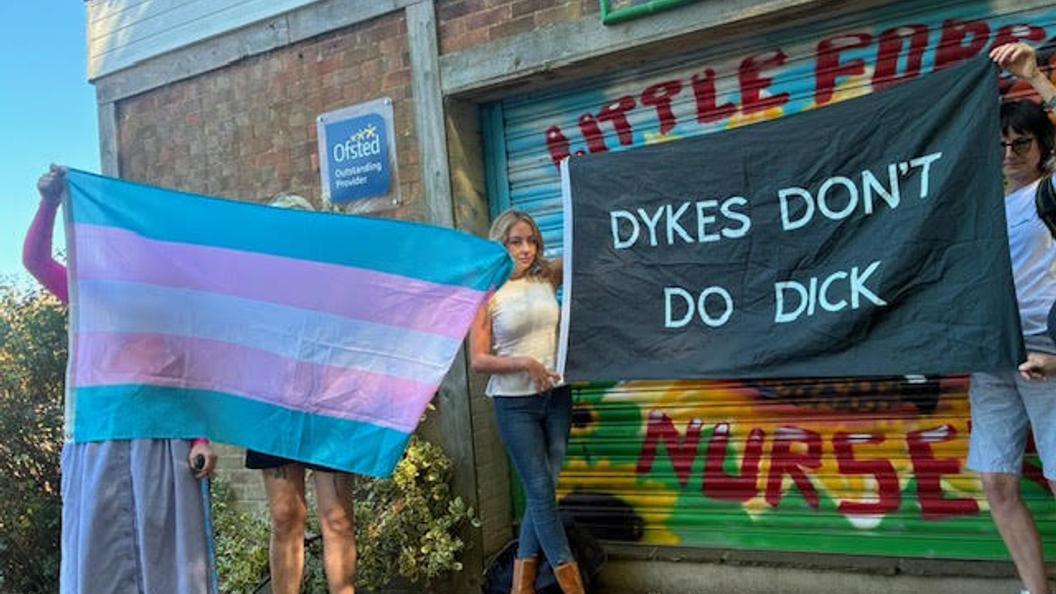
It started with a sign that said nothing more than: “THANK YOU SUPREME COURT.” Immediately, high-vis ‘safety wardens’ descended. One of the older women, who is reliant on a wheelchair took out her sign that said: “RECLAIM THE DYKE.”
And then, while a female safety warden, waving a bottle of beer in her hand, tried to stand in front of the two handmade signs and block them, we unfurled the massive black-and-white flag, made by THE Lily Maynard and gifted to Aja The Empress, who loaned it to me.
It read: DYKES DON’T DO DICK.
We stood on the outskirts of their event, silent. No chanting. No antagonising. No megaphones. Simply holding our signs. That was seemingly unacceptable to the ‘Dyke Pride’ crowd.
A trans-identifying young woman, about my age, came over to request that we drop the DDDD flag, but said we could stay with our other signs. Menno told her that was not an option, while he filmed the growing crowd of young women who proudly state they are lesbians while also having sex with ‘dick’ (read men), alongside aggressive and angry men in fishnets, lippy and cat ears who descended upon us.
I expected pushback from self-proclaimed lesbians who are actually bisexual and who are my age. What I didn’t expect was to see happily married lesbian couples in their 50s and 60s apparently disgusted by a flag that simply says lesbians don’t have sex with men. There were, fortunately, some nods from women walking past. There were also men in masks screaming in our faces.
I posted some pictures of the event on the Not All Gays social media accounts, and had some of the non-binary-identifying young women claim that the elderly disabled woman in our group was intentionally trying to mow down their non-binary partners. The video evidence showed multiple they/them ‘dykes’ repeatedly throwing themselves in front of her moving wheelchair, which I can only liken to insurance-claim fraudsters leaping onto car bonnets and claiming personal injury.
We stayed for about an hour. And we left not because of the 100-strong crowd screaming ‘we piss where we like’ and ‘no LGB without the T’, but because our signs were being snatched from our hands and destroyed. It’s astonishing to me that they were using the slogan ‘no LGB without the T’ at a dyke-specific event, when our signs said nothing about the T. They simply said that lesbians are their own thing. But alas, you cannot reason with - or begin to make sense of - an ideology that treats lesbianism as an identity for ‘non-men loving non-men’.
What these people seemed to think was ‘dyke’ pride was a celebration of men who call themselves non-binary and date women. Men who call themselves lesbians. Bisexual women who call themselves lesbians. Women who call themselves men. Essentially, anyone who wants in on lesbianism for virtue points. It isn’t a sexuality to these people. It is an identity. A political stance against ‘cishet men’. Everyone else, all and sundry, is welcome.
And that is precisely the problem.
Because if lesbian simply means ‘anyone who identifies as a lesbian’, then the word ceases to describe female homosexuality at all. It becomes circular. You are a lesbian because you say you are a lesbian.
And you can be a lesbian regardless of whether you are attracted exclusively to women, whether you are a man, whether you have sex with men, or whether you are sexually attracted to men. At that point, what exactly is the word lesbian describing?
But I’m glad we did it. Despite the aggression. Despite the ratio difference between the size of the two groups. Despite being, quite literally, a tiny group of tiny women (and allies) standing against a sea of people who appeared to believe we had no right to define our own sexuality. Someone had to do it. Someone, even if it was just a tiny group, had to say no. This is not Dyke Pride. Dykes don’t do dick. Dykes aren’t men. And men aren’t dykes. And we did.
I have received several DMs since, from women who were at that event, thanking us and telling me that they had been too scared to discuss this before. One told me that she saw me, my 5’2” shortarse, standing there against a load of angry men and women pretending to be men, and decided that she was going to seek out TERF events and get involved.
That, to me, is why it mattered. Not because we were going to change the minds of the people screaming at us. Not because we were going to win some great ideological battle on the steps of Brighton. But because sometimes simply standing there and refusing to move tells the frightened person watching from the sidelines that they are not alone.
Courage calls to courage, everywhere.
We weren’t a huge organisation, a political party, a funded NGO or a professional activist machine. It was a handful of women, a couple of allies, and Menno and Not All Gays, standing there with a flag saying something that apparently required extraordinary bravery to say out loud: Dykes don’t do dick.
We stood there in quiet defiance because lesbianism belongs to lesbians. Because women are allowed to define their own sexuality. Because homosexuality does not stop being homosexuality simply because somebody finds the definition politically inconvenient.
And because if we won’t stand up for lesbians, who will? If not us, who? If not now, when? So yes. It’s been a rough few weeks for the lesbians. But we’re still here. And we’re not moving.
To support and find out more about Not All Gays, visit https://www.notallgays.org/, Instagram and X.