In Quiet Dykefiance, We Remain
In the first of a two-part series, Not All Gays’ cofounder and president argues that the Dyke Bar farce is a mask-slip moment: “lesbian” has been captured by kinksters, bisexuals and men.
It’s been a rough few weeks for the lesbians. And perhaps more importantly, it’s been a rough few weeks for the word lesbian.
Because ‘lesbian’, for quite some time now, has been occupied as a political identity, an aesthetic, a community label, a kink identity, a gender identity, and seemingly anything else anyone wants it to mean, rather than having anything to do with what it actually means: a woman who is exclusively sexually and romantically attracted to other women.
That distinction is not some archaic technicality; it is the entire point. A lesbian is homosexual. A lesbian is female. A lesbian is a woman who is attracted to women. Take those three things away and you can call almost anything lesbian - and that is precisely what appears to be happening.
Nothing highlights this more than the recent ‘lesbian drama’ that has broken through the #WLW (women loving women) internet circles, reached mainstream news spaces and set X alight.
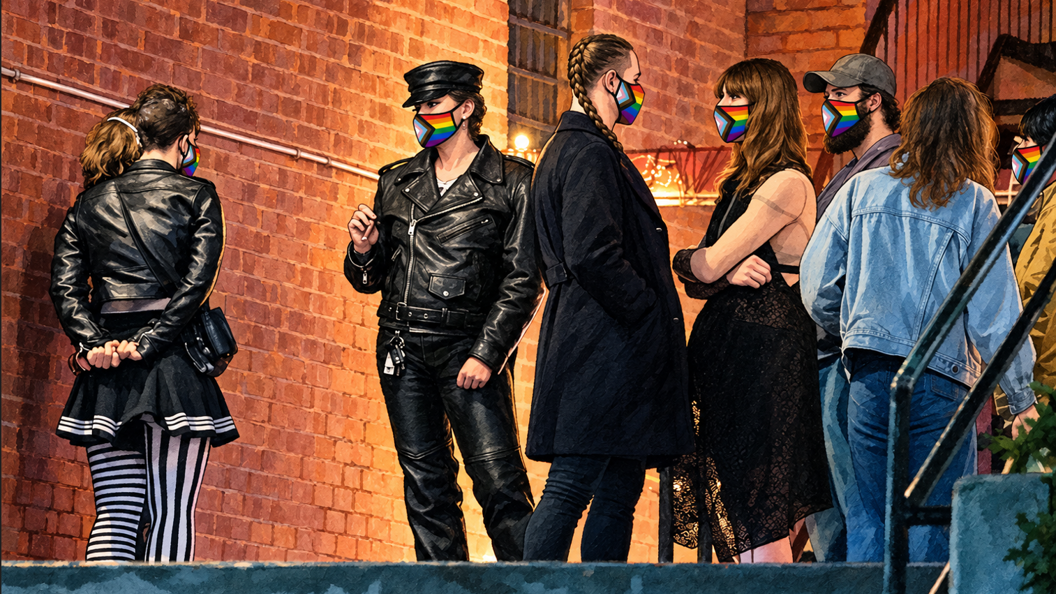
By now, I’m sure many of you will have heard of the so-called ‘COVID-conscious lesbian bar’ in Western Massachusetts. Yes, the one that mandated KN95 masks, and was accused of creating a ‘mass disabling event’, practising ‘eugenics’ and ‘white supremacy’ for considering making masking optional one night a week to keep the business afloat, while the remaining she/they owner apparently lives out of her car and works four jobs.
Many of the main players involved in this controversy are non-binary (of both sexes), queer-identified bisexuals, trans-identifying young women, and even trans-identifying men, all claiming to be lesbians and therefore making it a ‘lesbian bar’.
However hilariously insane that situation is, it unfortunately ends up with normal, actual lesbians being perceived in the same light as this authoritarian collection of mass hysteria that has come to surround the word ‘queer’.
And there it is. A lesbian bar, apparently, no longer needs to be a bar for lesbians. It simply needs to be a bar for people who identify with lesbianism. Which, rather conveniently, can include pretty much anyone. And then actual lesbians are left standing there wondering why the space supposedly created for us has increasingly little to do with us. This is the dilution of a word until it becomes meaningless. Because when a lesbian space can include all and sundry, the one thing that becomes optional is being an actual lesbian.
Just today, a 2024 podcast episode featuring King Princess - a musician who built her fanbase by claiming she is a lesbian, and one of the few we believed was actually providing representation for lesbians in the music world - resurfaced and went viral, once again breaching the sound barrier of the online lesbian circles.
She proudly declared on Celebrity Book Club with Steven & Lily that when she is bored she will “ride d–k”, and that when she is abroad she will find a man to have sex with, but that apparently doesn’t make her bisexual, or any less of a lesbian. She then proceeded to berate actual lesbians for being ‘strict’, while one of the co-hosts accused lesbians of being misogynists for taking issue with someone who regularly and continuously “takes a lot of d—k” calling herself a lesbian.
Je désespère. This is what lesbian has been reduced to.
And perhaps this is the fundamental problem. Lesbianism was never supposed to be an aesthetic, a political affiliation, a community membership card or a statement of opposition to ‘cishet men’. It describes female homosexuality. It describes women who are exclusively sexually and romantically attracted to women.
Read Part II in TERF Times tomorrow.
To support and find out more about Not All Gays, visit https://www.notallgays.org/, Instagram and X.