I watched, so you didn't have to
Report from Draft Conversion Practices evidence session
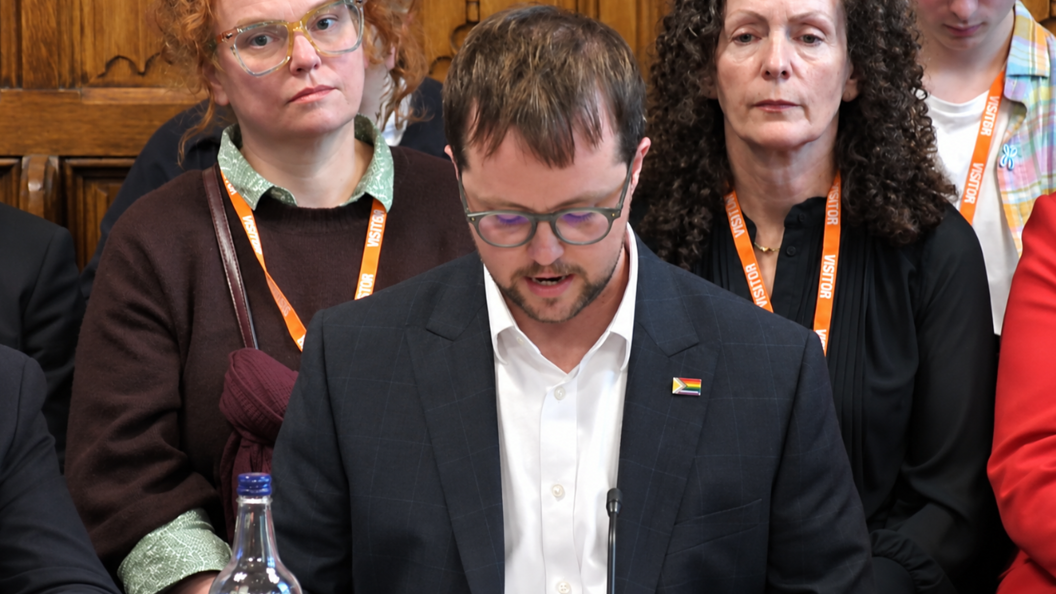
The first hearing of the Draft Conversion Practices Bill Joint Committee opened with a trigger warning because of the potentially distressing content. Having sat through it, I can confirm: it was distressing.
Chair Alex Barros-Curtis MP then introduced the first panel: Stephen Kiely, Stonewall’s head of policy and public affairs; Kai O’Doherty, Galop’s director of policy and research; and Professor Ilias Trispiotis, a member of the Ban Conversion Practices Coalition’s steering group.
Ahead of the meeting, Rosie Duffield MP, who left the Labour Party after severe harassment for her sex realist views, posted online, questioning whether the committee chair could be trusted to scrutinise the legislation fairly. She noted that Barros-Curtis had spent 13 months investigating her over “one like of one tweet” and suggested he was essentially a trans activist,
O’Doherty, a trans-identified woman who previously worked for Mermaids, noted it had taken eight years for the bill to make it into the King’s Speech. She said a survey due to be published next week found that 4% of LGBTQ people surveyed had been offered conversion practices and 1% had undergone them. Unsurprisingly, the figures were much higher among respondents from ethnic minorities and those who identified as trans (who are notably, much more likely to have comorbid mental health problems…).
She set out her case with the story of a lesbian referred to as Jane, who was apparently bathed in holy water by her religious parents and abused by her church. O’Doherty said most victims were subjected to conversion practices by their parents or religious leaders.
A member of the committee asked whether there had been any prosecutions in countries where such legislation had passed. Trispiotis said there was no data because the laws had not been in place long enough.
Trans activist Olivia Bailey MP then introduced herself by reminding the room that she was responsible for drafting the bill and had already met most of those giving evidence (presumably just from the pro bill side). She asked, somewhat helpfully, why a specific law was needed on top of existing ones.
Trispiotis replied that it was necessary because coercive control applies only to existing familial or intimate relationships. Hate crime law is insufficient, he argued, because it requires an underlying offence and the protected characteristic to be treated as an aggravating factor. Civil remedies are impractical because a breach of a duty of care has to be proved.
The next question came from the Rt Hon Sir Jeremy Wright KC MP, who cheerfully announced that he had already spoken to all the trans activist witnesses. He asked whether the bill should include suppression of an identity, and whether it works both ways when it comes to changing someone’s identity or sexual orientation.
Trispiotis argued that suppression should be added to bring the bill into line with other legislation elsewhere in the world. He defined it as acts or conduct that aim to convince someone to deny or conceal their sexual orientation or gender identity. He seemed little concerned about defining suppression precisely, noting instead that legislation elsewhere offers examples.
O’Doherty claimed that people who subject others to conversion practices are sneaky. They no longer say, “Don’t be gay”; instead, they say, “Just don’t show anyone you’re gay.” She said it was crucial to include suppression in the bill. She went on to list examples from Galop service users, including being prevented from seeing people outside the home and having their online communications surveilled. There was no mention of how old those allegedly victimised in this way were.
Trispiotis then said he saw no reason to distinguish between “abusive” and “non-abusive” practices because, in his view, any attempt to change or suppress an identity is abusive. So if he gets his way, telling a human pup to stop pissing on lampposts would be abusive…
Bailey piped up again to ask whether the draft bill should distinguish between sexual orientation and gender identity.
Kiely welcomed the addition of asexuality and non-binary identities to the bill, claiming both groups face attempts to convert them. (I’d warn readers against asking a non-binary asexual out lest they be criminalised, but that seems redundant.)
Then Wright asked about a carve out for healthcare providers.
Trispiotis replied that other jurisdictions had listed actions such as “providing open-ended support” to ensure only the baddies are caught by the legislation. The faces behind him at this point are worth watching.
O’Doherty added that there should be no exemption at all. She cited the example of an asexual person told by a doctor that their low libido might be a sign of a medical condition.
Asked whether someone who prays with a religious figure for guidance about their identity or orientation might put that person at risk, Trispiotis replied that, with the harm threshold so high, prayer would be unlikely to be caught.
Conservative peer Baroness Browning asked how the rights of parents to protect their children would be balanced against those of a “stroppy teenager” who might claim ‘alarm and distress’.
Trispiotis directed her to the bill’s explanatory notes, but floundered when asked what it might mean in practice. Kiely swooped in, saying the definition matched the one in the Serious Crime Act: bodily harm, psychiatric injury and serious distress. Trispiotis took the opportunity to remind everyone that he’s a legal academic, and explained that the model is similar to coercive control.
Liberal Democrat MP Marie Goldman, the party’s Women and Equalities spokesperson, said she had met Stonewall previously in that role. She asked how easy it might be for victims to demonstrate harm. Trispiotis jumped in again, saying it was really hard to prove as with coercive control.
Shah then had a short verbal tussle with Trispiotis, who refused to accept that the bill would criminalise parents who did not affirm their children’s identities. He repeated that the bar was very high but that it was difficult to answer in the abstract.
The chair cut Shah short and moved to a question from the Rt Hon the Baroness Prentis of Banbury KC about protection orders. O’Doherty said they might work like Stalking Protection Orders, though these are apparently hard to obtain. The witnesses agreed they weren’t perfect, but were necessary.
Prentis asked who might apply for protection orders. In short, the witnesses weren’t sure.
Round two saw Dennis Kavanagh of Gay Men’s Network, Helen Joyce of Sex Matters and Dermot Kehoe of LGB Alliance, speaking against the bill. And it was a joy, so I’ll leave you to watch that yourselves.