Five Years Inside Lib Dem Conference
After years of censorship, slurs and attempts to silence them, Liberal Voice for Women has won a place in the debate and put women's rights on the political agenda
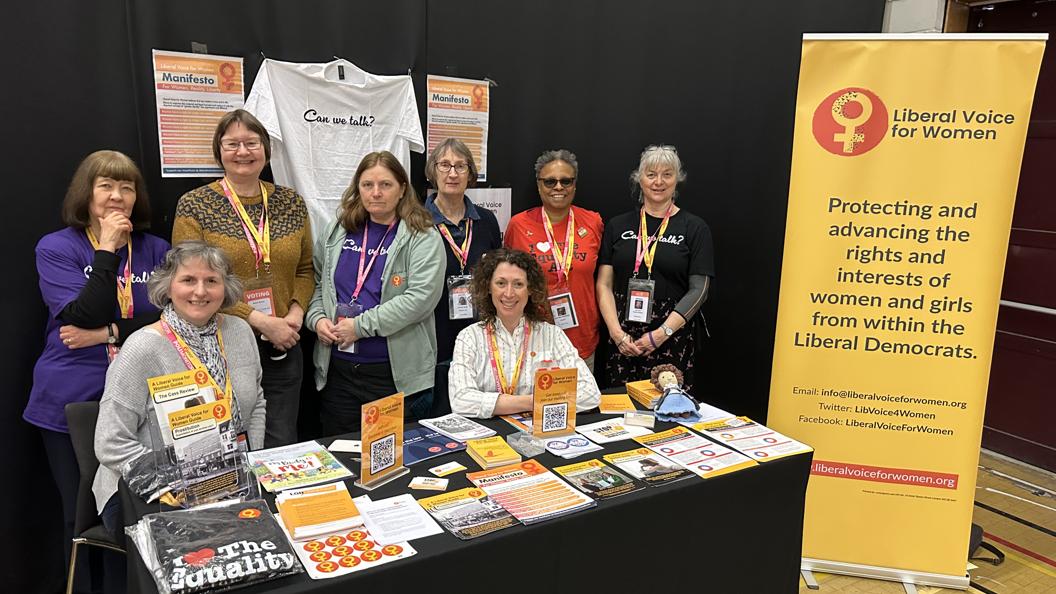
For five years, I’ve attended Lib Dem conference with Liberal Voice for Women (LVW), watching the Party move from open hostility to grudging, uneven progress on gender-critical views. There’s still a long way to go, but that shift shows what persistence and collective action can achieve.
2021 and 2022: “No Debate!”
The first time I saw censorship within the party was at the online Autumn 2021 conference. Speaker cards opposing the “Ban Conversion Therapy” motion were rejected on various grounds; the one that got through was never called, apparently because of “technical problems”. Six months later at the Spring Conference, I asked a polite question at Liberal Democrat Women’s online “Woman Friendly Parliament” fringe about women’s concerns over Gender Recognition Act reform. Within a minute, I was accused of transphobia and people were demanding I be removed. Supportive comments were deleted.
That same conference, LVW won an amendment restoring “sex” to the Party constitution’s protected characteristics, after it had dropped out when “gender identity” was added. Trans activists moderating the chat condemned the speech and removed positive comments. Complaints went nowhere, but in 2023 the Code of Conduct was updated to say moderators must not favour one side or silence views they disagree with. That rule has since helped open up debate on the Party’s internal Facebook groups.
Spring 2023: The Hostile Hall
Our next constitutional amendment sought to base the Lib Dems’ internal women’s quota on sex, not self-ID. The Party had to debate it, and the hostility at our first chance to make our case was palpable. “Trans rights” T-shirts and hoodies filled the foyer and the hall. We felt deeply unwelcome.
On the morning of the debate, the Young Liberals tried to strike the amendment from the agenda, calling it “administrative bigotry”. They failed, but I feared I would not get to explain that the amendment was about following the law, not the other charges levelled against us. After For Women Scotland 1, it was clear that self-ID was unlawful. I had never spoken at conference. All day, I rewrote my speech and paced the kitchen, rehearsing a five-minute version for a full debate and a two-minute one in case activists tried to shut it down.
That evening, as crowds in trans-rights regalia filed past, Leader Ed Davey, Women and Equalities spokesperson Christine Jardine and Chief Whip Wendy Chamberlain took their places. A “Move to Next Business” motion threatened to end the debate. Its proposer slurred LVW and suggested the Federal Conference Committee should never have accepted our amendment. I had two minutes to explain what it was really about. I began with the Party’s slogan: “This is about a Fair Deal… a Fair Deal for the women in this party.” There was applause. But when I explained that the quotas allowed male people identifying as non-binary into the women’s quota, the hall erupted: “Shame!” “Bigot!” The heckling briefly silenced me.
The hall voted to shut down the debate. We watched in astonishment as the Party leadership, including Ed, Christine and Wendy, raised their hands in support.
Afterwards, members came to thank us. “Thank you for trying to save the soul of the Party,” one councillor said. The next day, as we handed parliamentarians copies of Time To Think, one asked, “Why can’t you lot just be kind?” My colleague Alison Jenner answered: “We are being kind. We are being kind to the woman in prison and the women who have been raped and need female-only counselling.”
2023 and 2024: Breaking Through
Our first fringe in Autumn 2023 was a milestone, and we were thrilled to welcome the wonderful Jenni Murray. The Party initially accepted our advert for its official conference literature, then withdrew it. When our letter citing the Equality Act went unanswered, we took the story to journalists in the press area. The Chief Steward ushered us out, but several outlets reported the censorship. Despite it all, the fringe was a success, with none of the disruption seen at similar events in other parties.
But by Spring 2024 we all felt bleak: our legal case against the Party was under way in order to get equal treatment with other members, but nothing seemed to be moving. By Autumn though, it was finally bearing fruit. The Federal Conference Committee still voted to deny us a stand, but was overruled on financial grounds. We were granted a stand four days before conference. Activists claimed our presence made trans people unsafe, prompting me to appeal for calm.
As a form of protest to our presence, trans flags and posters appeared across the hall and a giant trans flag was unfurled outside; parliamentarians were reportedly told not to be photographed at our stand. An Afghan women’s motion we submitted made the ballot, then narrowly missed getting it to the conference floor after a trans activist campaigned against it when he realised we were associated with it.
On Sunday, then-President Mark Pack told conference he regretted our presence and said we made trans people feel unsafe. Hours later came reports that male activists had spun a gender-critical woman in a revolving door. Complaints went nowhere for lack of corroborating evidence.
In the hall it became clear not everyone displaying trans paraphernalia agreed with the ideology. One member confided that he didn’t want the trans flag draped over his stand, but a colleague had insisted and he decided it wasn’t worth the argument. Elsewhere, activists left small knitted pink-and-blue items on stalls, sometimes when their owners were absent and had no chance to object.
Some sought LVW out: one MP’s staffer said, “Good, I’ve found you. I agree with everything you say.” Members stayed for 15 or 20 minutes at our stand, often grateful to discuss a subject they could not raise in their local parties. Our quiet dignity, one stallholder said, had been noticed.
2025 to today: Progress and Setbacks
Things have changed. Since Autumn 2024, we have spoken at all three sex-and-gender debates. In Spring 2025, five speakers opposing “Free To Be Who You Are” were called, though the motion passed. In Autumn 2025, the women’s-quota debate was rerun after the Supreme Court ruling, then shut down again by a “Move to Next Business”. Almost all the MPs left before the debate began. The Party eventually took legal advice, which confirmed its quotas did not comply with the Equality Act; a review is now under way. This time, the non-debate was reported by outlets including the BBC. The Party could no longer keep its position quiet. Voters were watching.
At this Autumn’s conference, “Restoring Trans Rights” passed as an emergency motion. I was one of only two speakers against it, given the debate’s brevity. Heckling was quickly hushed: activists seem to have learned that men shouting “Shame!” at a woman discussing women’s rights is poor optics. My speech on the Darlington nurses case and self-ID was widely shared, including by Kemi Badenoch. The motion is now Party policy. It seeks to disapprove the EHRC guidance and amend equality law - though how remains unclear. The Lib Dems are not in government, but we should not be complacent if coalition talks with Labour ever arise.
Our stand however is busier than ever. Many new members joined us this conference, and more young people are finding a place where they can speak freely.
The future
Had we given up in 2022 or 2023, when even the leadership voted to silence us, we would have none of this: a growing membership; conference stands; greater awareness across the Party; parliamentarians and councillors asking for briefings; and a Party now changing its rulebook to comply with the Supreme Court. Meanwhile, Green Women’s Declaration has still not been allowed a stand at the Green Party conference. Every year we show up, our presence becomes more normal.
The Lib Dems were not always captured on this issue. Like many organisations, they were approached by activists who appealed to people’s kind-heartedness. Vague support hardened as opponents were driven out by complaints and hostility, while those committed to the ideology made the organisation their home. Some Lib Dem councillors are now trying to find ways around the Supreme Court ruling; others, with our support, are working for compliance.
I know how hard it is to stay and fight. I know what it is to stand at a lectern while a hall shouts “Shame!”, to watch your own leadership vote to silence you, and to be vilified, censored and abused.
We cannot cede political and legislative power to activists. Entrenched ideology will not yield to reasonable requests or private, polite persuasion over cups of tea. It has to be pulled out by the roots, and that takes more strength than we have now.
Strength means numbers. Think of the vote that put “Restoring Trans Rights” on the agenda: fewer than 200 ballots, and a few dozen more in the other direction could have changed the result. In the Greens, 200 more votes would have sunk “Zionism is Racism”. These institutions are not held by overwhelming majorities.
The success of trans activism depends on people displaying the sign, keeping their heads down and quietly complying. It begins to crack the day enough people stop. Every member who speaks out, votes with their conscience or simply refuses to go along makes it easier for the next one to do the same.
So, join. Rejoin. Show up to the meeting, the conference, the count, the AGM and even stand as a councillor or MP. Bring reinforcements - a friend who feels politically homeless. Nobody is coming to hand these institutions back. We will have to take them back, one member, one vote, one refusal to stay quiet at a time.
The fight is hard, but it is winnable. Every member who joins it makes the next fight easier to win. And the next member could be you.
*A quick note on how the Liberal Democrat conference works. Any ten members can submit a motion, and the Federal Conference Committee (FCC) decides whether it gets debated. This triage offers some protection against fiascos like the Green Party’s “Zionism is Racism” motion. Constitutional amendments, by contrast, must be taken if they are “in order”. Any attendee who is a member can submit a speaker’s card, the Chair selects speakers, and every attendee gets a vote.