
Bean at the Tory Conference
First published in The Critic magazine. The Conservatives may be the only party left where women and LGB people can speak freely about their rights
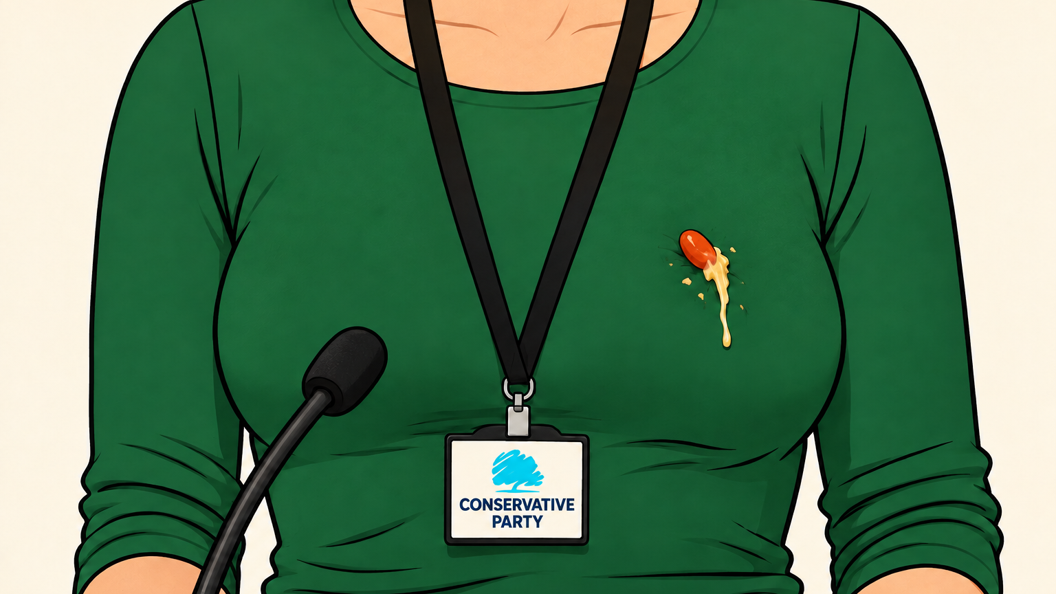
In the background, a group of young lads in suits were spluttering at each other about business rates with the boyish enthusiasm of plane-spotters. Smiling indulgently to myself, I looked down and saw a cold baked bean left over from lunch, fused to my top with cheese. After heading to the loo to scrub it off, and emerging with a large wet patch around my left boob, I went to hear some exquisitely well-presented Conservative women talk with passion and intellect about the Equality Act.
Looking at these hyper professional and dedicated party members, it occurred to me that the Tories would never be my spiritual home. But despite that, I don’t think there’s another party out there where women would be so welcome to speak about their rights; nor lesbians, gays and bisexuals theirs. And for that, I am grateful.
I was there, at the invitation of LGB Alliance to talk about the draft bill to ban conversion practices. What has been proposed is so disingenuous it would’ve made Johnathan Aitken blush. It sounds like a bill to stop mad homophobes from strapping electrodes to the foreheads of gay men. In fact, the Bill does something much worse: it criminalises any dissent from the opinions of trans activism.
The draft Bill’s definition of a conversion practice includes any conduct intended to influence whether someone has, or believes they have, a particular sexual orientation or gender identity. There doesn’t need to be any relationship between the person who considers themselves a victim, or the alleged perpetrator. “Abuse” is left for the courts to decide, with a list that includes economic, psychological and emotional pressure. If the practice causes serious alarm or distress that substantially affects someone’s day-to-day life, the offender faces up to five years in prison.
This means a husband who cross-dresses might demand that his wife spend household money on “gender-affirming” lingerie and insist she accept their marriage as a lesbian relationship. If she refuses, he could claim she is using economic or emotional pressure to make him abandon his transgender identity. Or a parent who refuses to buy a binder, use a new name or let a child spend hours watching trans influencers on TikTok could face the same accusation. In the latter case, the child could be made the subject of a protection order, the family drawn into court proceedings and potentially, all of those in the house who are under 18 could be taken into care.
These are not fanciful readings: the Bill expressly puts economic and emotional pressure within the court’s frame for deciding abuse, and there is no definition of a transgender identity. Already, trans activists are circling on Reddit looking for how best they might use the law to persecute gender critical therapists.
The Bill also puts journalists and organisations on notice. An article aimed at persuading readers that gender identity is not real could be alleged to be conduct intended to make trans-identified readers reject their identity. A request that a man use the men’s loos could be presented as an attempt to make him deny his identity. That does not mean either example automatically meets the criminal threshold. It means the Bill invites complaints, investigations and costly legal battles over speech and ordinary conduct.
Trans activism has already driven a tank through family life and freedom of speech. Just last week the Mail on Sunday reported from a parents’ group where 17 members had been reported either to the police or social services for declining to affirm their children’s cross-sex identities. If passed in its current form, this bill will hand trans activists a cudgel with which to beat their opponents.
There have now been four attempts to introduce ‘trans inclusive’ conversion therapy bans. The most recent offering is backed by a manifesto pledge, a sop to the trans activists within the Labour Party who were wounded by last year’s Supreme Court ruling on sex. Equality Minister Olivia Bailey, who introduced the draft bill, is also on the committee scrutinising it.
This ought to be an easy win for the Conservatives. From family life to freedom of speech, what is being proposed rips through everything that the Right holds dear. But the misleading name, long shadow of Section 28 and the ‘nasty party’ image has made the Tories a bit mimsy.
Those who came to the discussion, held at an uncivilised hour in the morning, clearly cared. But how many of them will stand up and oppose a bill which the general public clearly believes is about stopping the physical abuse of lesbians and gay men?
These thoughts were still rattling around my head on the train home when a good-natured man, laden with tote bags and freebies, took the seat opposite. He asked what had brought me to conference, and I explained I’d been speaking about the draft conversion practices Bill. His brow furrowed. He was, he told me, “a fiscal conservative but social liberal”.
We talked a little more. He agreed the Bill risked overreach, but worried about protecting “children who really are trans” or the nice transsexuals he’s met who’ve had the chop and “lived as women” for decades. I wanted to ask which other forms of mental distress we treat by altering healthy bodies, and what exactly he thought ‘living as a woman’ means. But he was a nice chap, doing his best, so I let it go.
What made him sit up was the prospect of burdening the courts: the messy overlap between family and criminal proceedings, the cost of taking children into care. I urged him to use his voice and speak out against the Bill. Looking somewhat embarrassed he said:
“But I’m a straight white man. I don’t think it’s my place.”
The implication, however well-intentioned, was that this Bill is identity politics: a side issue. I doubt he’d be so coy about the “big issues” of taxation and foreign policy, where men like him rarely question their right to speak.
I thought of the women in the party, including its leader, Kemi Badenoch, who have put their heads above the parapet and weathered accusations of transphobia. How much easier their fight would be if men like my fellow passenger used the authority they enjoy as straight white men to stand beside them, instead of wringing their hands behind them.
First published in The Critic here.