Battling for feminists
This year’s Battle of Ideas came alive when feminists joined the debates
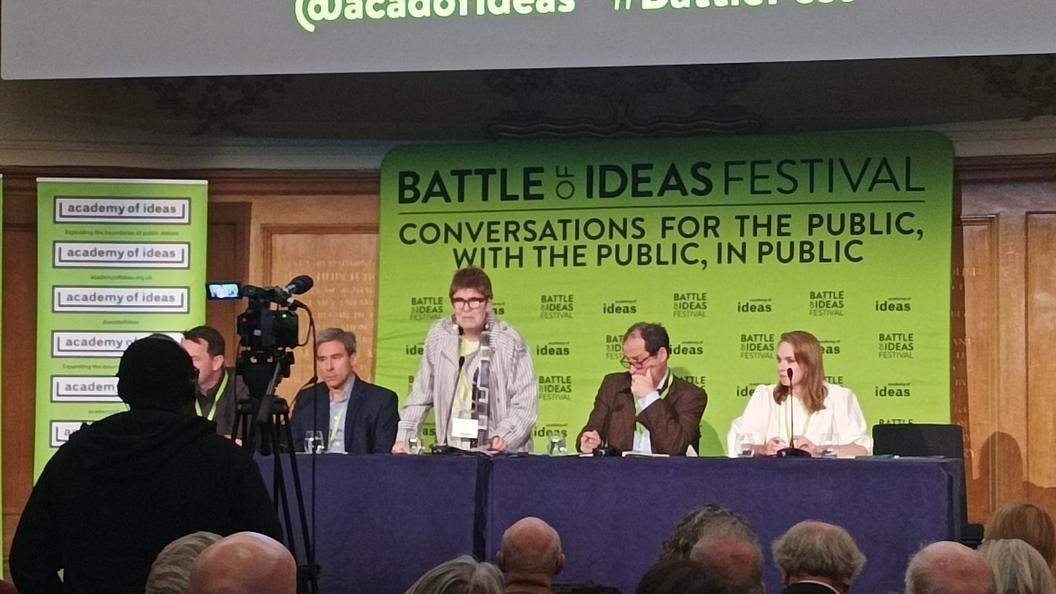
“I think most of us want to save Western civilisation,” declared Baroness Fox during the Suicidal Empathy panel at the Battle of Ideas. As she defended democracy and the free exchange of ideas, Limoges town hall blazed and riots were erupting across France and neighbouring countries.
Feminists have long argued that the liberal values underpinning the West are too often turned against women: in the name of “freedom”, we are told to accept everything from pornography to male fetish. But freedom of speech is also how citizens challenge power, contest ideas and make their voices heard. Feminists must be able to use it too.
That principle lies at the heart of the Battle of Ideas Festival. Its motto is ‘Conversations for the public, with the public, in public’; its slogan, emphatically capitalised, is ‘FREE SPEECH ALLOWED’, and there can be no doubting Fox’s commitment to this aim, including for those with whom she disagrees.
Great care was taken to maximise audience contributions, generate discussion and encourage disagreement: specific ‘Go On, Convince Me’ sessions aired unpopular, in the Battle context, opinions defending liberalism, advocating not banning the burqa and championing the end of the ‘United’ Kingdom.
The Battle prides itself on being ‘a living, breathing example of free speech in action’, and Westminster’s Church House teemed with activity as over two thousand participants hurried to bag seats at well over a hundred debates and discussions on a huge range of topics, from terrorism, disinformation and antisemitism through council housing and social care to populism, elections in France and the rise of the ‘femosphere’. Popular sessions were standing room only; conversations overflowed into the lunch queue and later spilled out into corridors, pavements and nearby pubs.
Its commitment to free speech notwithstanding, the Battle is hardly politically neutral. Sponsored by Ben Delo, the crypto-billionaire who recently donated £36 million to the Reform party, its right-leaning, libertarian sympathies were evident across the programme, with a keynote session with Reform MP Danny Kruger, podcasts with Spiked!, The Spectator and the Daily Telegraph, and panels featuring conservative academics and commentators. Many of the panels were male-dominated.
As might be expected in such an environment, analyses of power relations were pretty thin on the ground: concepts such as inequality and oppression were generally referred to only to be dismissed, while ideas of meritocracy and the prized ‘free speech’ itself were invoked with little critique. That said, dissenting voices were platformed, one example being an excellent panel on ADHD and autism. While Delo funds a charity to support young people with autism, the panel featured trenchant contributions that were extremely critical of over-diagnosis and pathologisation.
But aside from conservatives and libertarians, the most prevalent voices were those of feminists and campaigners for women’s rights and LGB rights. Baroness Sharron Davies and LGB Alliance Chief Executive Kate Barker spoke to a packed room on the puberty blockers scandal, while Faika El-Nagashi and Helen Joyce contributed to a high-profile session on the dangers of the Conversion Practices Bill. Bethany Hutchison spoke of the courageous and victorious struggle of the Darlington nurses to ensure women-only provision; Dennis Kavanagh and Shahrar Ali defended the 2010 Equality Act as a vital means of tackling discrimination. Journalists Jo Bartosch, Genevieve Gluck and Julie Bindel spoke compellingly on reproductive technologies, women’s independent publishing and surrogacy. Feminist perspectives were not only represented in the programme: women’s groups and ‘gender critical’ organisations had a visible presence in the main halls, with Feminists Against Antisemitism, Sex Matters, the Women’s Rights Network, LGB Alliance, Our Duty and Bin the Bill all busy with stalls and leaflets.
Equally important were the contributions from the floor: at several sessions I attended, audience members expressed feminist perspectives with great eloquence, each time receiving a perhaps surprisingly enthusiastic reception.
For me, one of the great benefits of feminist participation was the chance to contribute and challenge ideas. The programme may platform antifeminists such as Ella Whelan, but it also gives feminists the chance to expose the limits of their arguments, as Joan Smith did on a 2025 panel on women’s safety.
Another obvious benefit was straightforward awareness-raising. Hundreds more people are now aware, for example, of the urgent need to stop legislation that would criminalise parents, professionals and indeed anyone who fails to go along with the pretence that a girl is really a boy or vice versa. Among those hundreds of newly informed people will be those who will take action and start conversations. Who knows what the potential impact of this might be, what crucial difference it could make?
So what of our panel on Suicidal Empathy and the question of saving Western civilisation? During the discussion, a feminist in the audience launched a spirited defence of ‘lefty feminism’ and another suggested reframing the idea of ‘suicidal empathy’ as a ‘fawn’ response to a threat. Both contributions added valuable perspectives to the discussion and were warmly received. There was a general consensus that Western civilisation was worth saving.
Meanwhile, the town hall in Limoges continued to blaze and cities across Europe fell further into lawlessness. In alarming times of rapid change and increased polarisation, where the once-familiar becomes strange and old certainties are destabilised, it is crucial that those who care about women are in the room, making their voices heard and participating in public life as fully as possible.